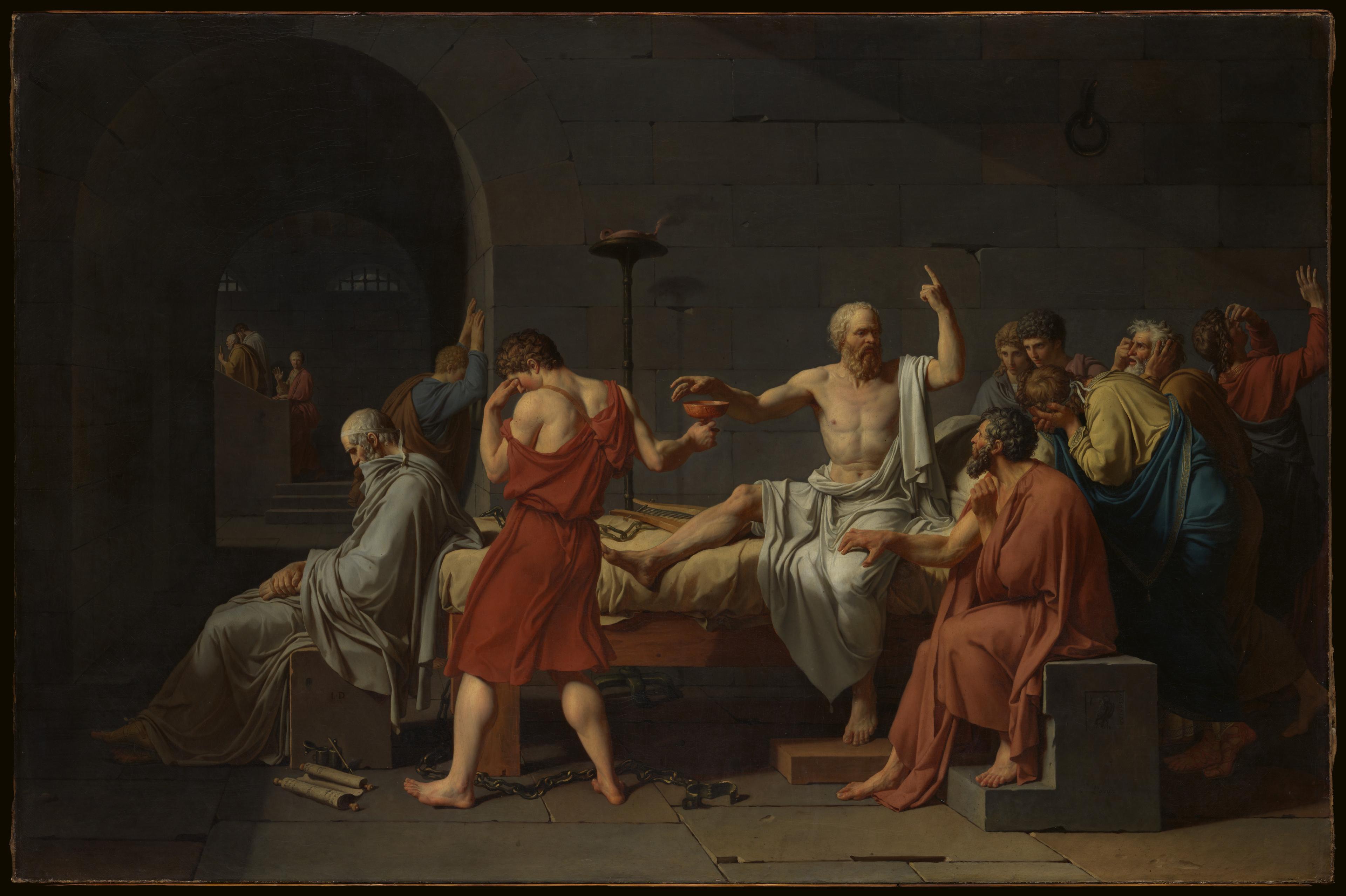
The Death of Socrates
Jacques Louis David
606 likes16 comments
Paintale uses cookies for essential site functionality and, where enabled, to serve relevant advertising via Google AdSense. You can accept all cookies or reject non-essential ones. See our Privacy Policy for details.
Now viewing
Capture of the Tripoli by the Enterprise
Thomas Birch American, born England
Period
1780-1830
Theme
Tragedy & Death
Medium
Oil on canvas
Current Location
Art Institute of Chicago, Chicago
The Story
At the turn of the 19th century, conflict arose between the United States of America and the North African Barbary State of Tripoli. President Thomas Jefferson refused to continue to pay tribute or ransom to Tripoli to prevent the pirating of American merchant ships sailing in the Mediterranean Sea. Jefferson dispatched the American ship Enterprise to the Tripolitan waters as a sign of resistance just as Tripoli increased its tribute demands and declared war against the United States.
Thomas Birch, an early specialist in maritime painting, captured the battle between the Enterprise and a Tripolitan cruiser in the Mediterranean’s dark, violent waters. The break in the clouds sheds light on this conflict and illuminates Birch’s fine details and precise rendering of these ships.
Working in Oil on canvas at 45.1 × 65.1 cm (17 3/4 × 25 5/8 in.), Thomas Birch American, born England constructs depth through value contrast rather than outline, letting figures emerge from darkness the way they would under candlelight or through a shuttered window.
Look closely and the painting opens up. Objects you might pass over — a folded letter, a half-drawn curtain, the angle of a glance — were placed to be read. Light hardens into edge, drapery becomes shroud, and the body is staged like an argument about mortality.
Art Institute of Chicago in Chicago now holds the work, where conservators and historians continue to revisit its condition and attribution. Each generation of scholarship adds a layer to how Thomas Birch American, born England's output from this period is understood.
“A silence so complete it becomes its own witness.”
This painting features documented symbols with their own dedicated meaning in art history:
At the turn of the 19th century, conflict arose between the United States of America and the North African Barbary State of Tripoli. President Thomas Jefferson refused to continue to pay tribute or ransom to Tripoli to prevent the pirating of American merchant ships sailing in the Mediterranean Sea. Jefferson dispatched the American ship Enterprise to the Tripolitan waters as a sign of resistance just as Tripoli increased its tribute demands and declared war against the United States. Thomas Birch, an early specialist in maritime painting, captured the battle between the Enterprise and a Tripolitan cruiser in the Mediterranean’s dark, violent waters. The break in the clouds sheds light on this conflict and illuminates Birch’s fine details and precise rendering of these ships.
Through prior acquisition of the Charles H. and Mary F. S. Worcester Collection
Inscriptions: On back: "Capture of the Corsair Tripoli by the / Enterprise under Sterrett and Porter / Off Malta August 1803 / T. Birch, Pinxit.".
Major William Boerum Wetmore, New York; Hiram Burlingham, New York; sold at Anderson Galleries, New York, January 11, 1934; French and Company, New York; private collection, Connecticut, to Richard York Gallery, New York, by 1991; sold to the Art Institute of Chicago, 1991.
Art Institute of Chicago, Chicago. View on the museum’s official page.
See more works at Art Institute of Chicago or browse the full Thomas Birch American, born England collection.
A restrained palette and sculptural lighting create a solemn geometry. The wooden crate and letter anchor the narrative with journalistic precision.
Sources
Keep Exploring
More paintings like this
Jacques Louis David

Francisco Goya
Charles Emile Callande de Champmartin

Raphaelle Peale
Caravaggio
Guido Cagnacci

Sandro Botticelli

Sandro Botticelli