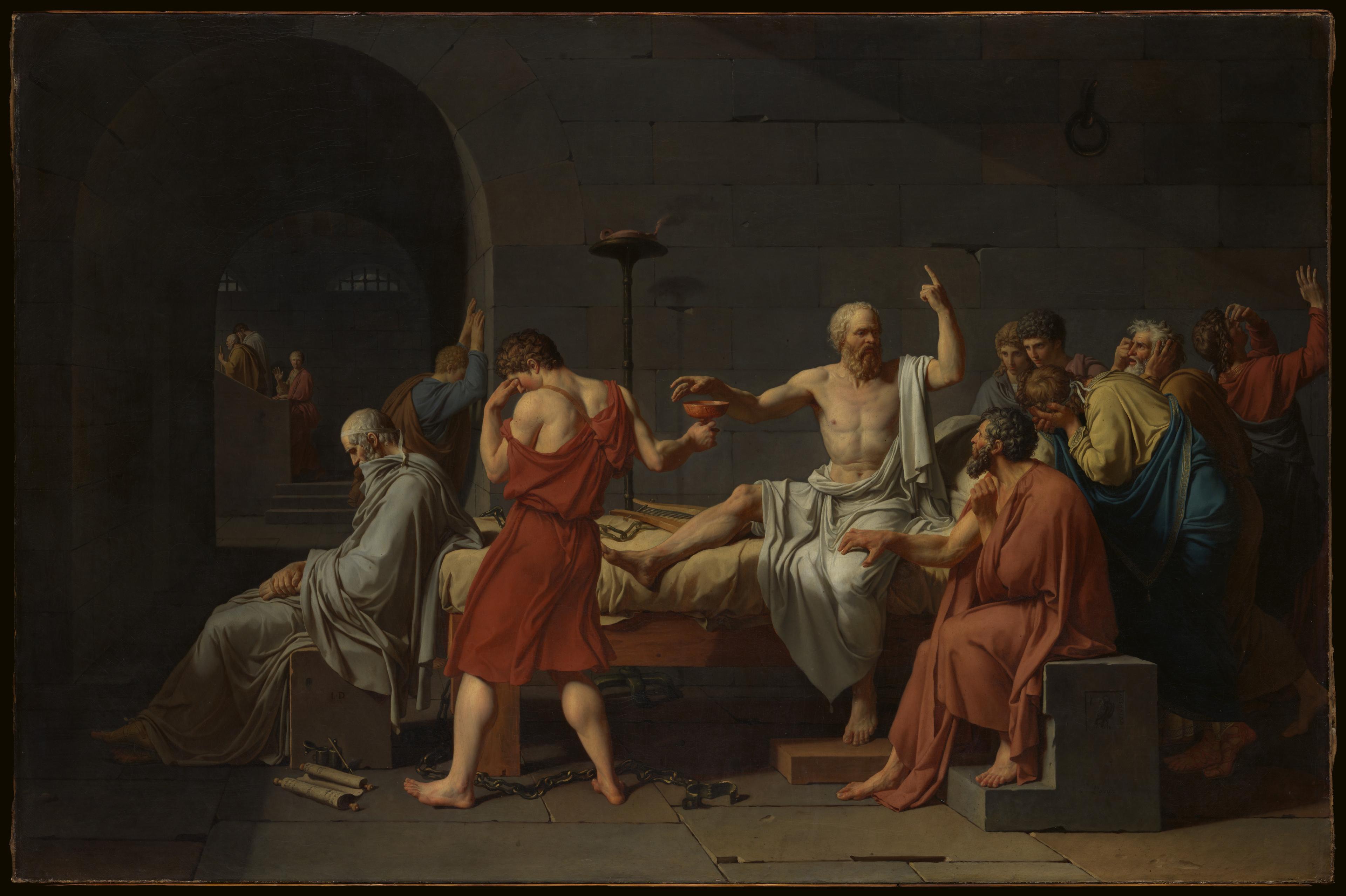
The Death of Socrates
Jacques Louis David
606 likes16 comments
Paintale uses cookies for essential site functionality and, where enabled, to serve relevant advertising via Google AdSense. You can accept all cookies or reject non-essential ones. See our Privacy Policy for details.
Now viewing
Théodore Géricault on His Deathbed
Charles Emile Callande de Champmartin
Period
1780-1830
Theme
Tragedy & Death
Medium
Oil on canvas
Current Location
Art Institute of Chicago, Chicago
The Story
This haunting image of a dead man swathed in white sheets was thought to have been painted by Théodore Géricault until a cleaning revealed the signature of his friend and follower Charles Emile Champmartin. More recent research has shown that the painting depicts Géricault himself on his deathbed, having succumbed to chronic tubercular infection at the young age of 32. Géricault’s early death and bold artistry, which sought to challenge classical notions of beauty, made him emblematic of the trope of the tragic Romantic artist.
Images depicting his passing circulated throughout the 19th century, and talismanic copies of his death mask populated young artists’ studios.
The physical object — Oil on canvas, 45.6 × 55.6 cm (17 15/16 × 21 7/8 in.); Framed: 68 × 78.2 × 11.5 cm (26 3/4 × 31 × 4 1/2 in.) — carries its own history of handling and restoration. Charles Emile Callande de Champmartin's brushwork here moves between exacting description and looser, more suggestive passages, a balance typical of 19th-century American studio practice.
Look closely and the painting opens up. Objects you might pass over — a folded letter, a half-drawn curtain, the angle of a glance — were placed to be read. Light hardens into edge, drapery becomes shroud, and the body is staged like an argument about mortality.
Today the painting is held by Art Institute of Chicago in Chicago, where it remains a touchstone for understanding Charles Emile Callande de Champmartin's contribution to Western art. It has been studied, copied, restored, and argued over for centuries — proof that great paintings keep generating new readings long after their creators have gone.
“A silence so complete it becomes its own witness.”
This haunting image of a dead man swathed in white sheets was thought to have been painted by Théodore Géricault until a cleaning revealed the signature of his friend and follower Charles Emile Champmartin. More recent research has shown that the painting depicts Géricault himself on his deathbed, having succumbed to chronic tubercular infection at the young age of 32. Géricault’s early death and bold artistry, which sought to challenge classical notions of beauty, made him emblematic of the trope of the tragic Romantic artist. Images depicting his passing circulated throughout the 19th century, and talismanic copies of his death mask populated young artists’ studios.
A. A. Munger Collection
Technique: oil painting, painting, painting (image making), painting techniques.
Inscriptions: Inscribed upper left: C [or E] Champmartin.
Possibly Champmartin Sale, Paris, Hôtel Drouot, January 28-29, 1884, lot 273 [see Paris 1992]. Possibly Sale, Paris, Hôtel Drouot, January 28, 1888, lot 112 [see Paris 1992]. Foynard, Paris; sold to Richard Goetz, Paris, by about 1914 [according to Richard Goetz's letter of December 14, 1937 to Robert Harshe, stating that he acquired the picture “at ‘Monsieur Foynard’ before war, the same as all my other Gericaults I bought at the period. Formerly in the collection ‘Chamartin’ (sic),” copy in curatorial file]; sold with sequestered property of Richard Goetz, Paris, Hôtel Drouot, February 23-24, 1922, lot 138, but presumably bought in and retained by Goetz [see copy of annotated sale catalogue from Clark Art Institute, Williamstown, in curatorial file]; sold through J. Rosner, Paris, as agent for Richard Goetz, to the Art Institute in November 1937 [based on receipt 6376 in Registrar’s office and letter from Goetz to Harshe cited above; see also Adry 1937].
Art Institute of Chicago, Chicago. View on the museum’s official page.
See more works at Art Institute of Chicago or browse the full Charles Emile Callande de Champmartin collection.
A restrained palette and sculptural lighting create a solemn geometry. The wooden crate and letter anchor the narrative with journalistic precision.
Sources
Keep Exploring
More paintings like this
Jacques Louis David

Francisco Goya
Thomas Birch American, born England

Raphaelle Peale
Caravaggio
Guido Cagnacci

Sandro Botticelli

Sandro Botticelli