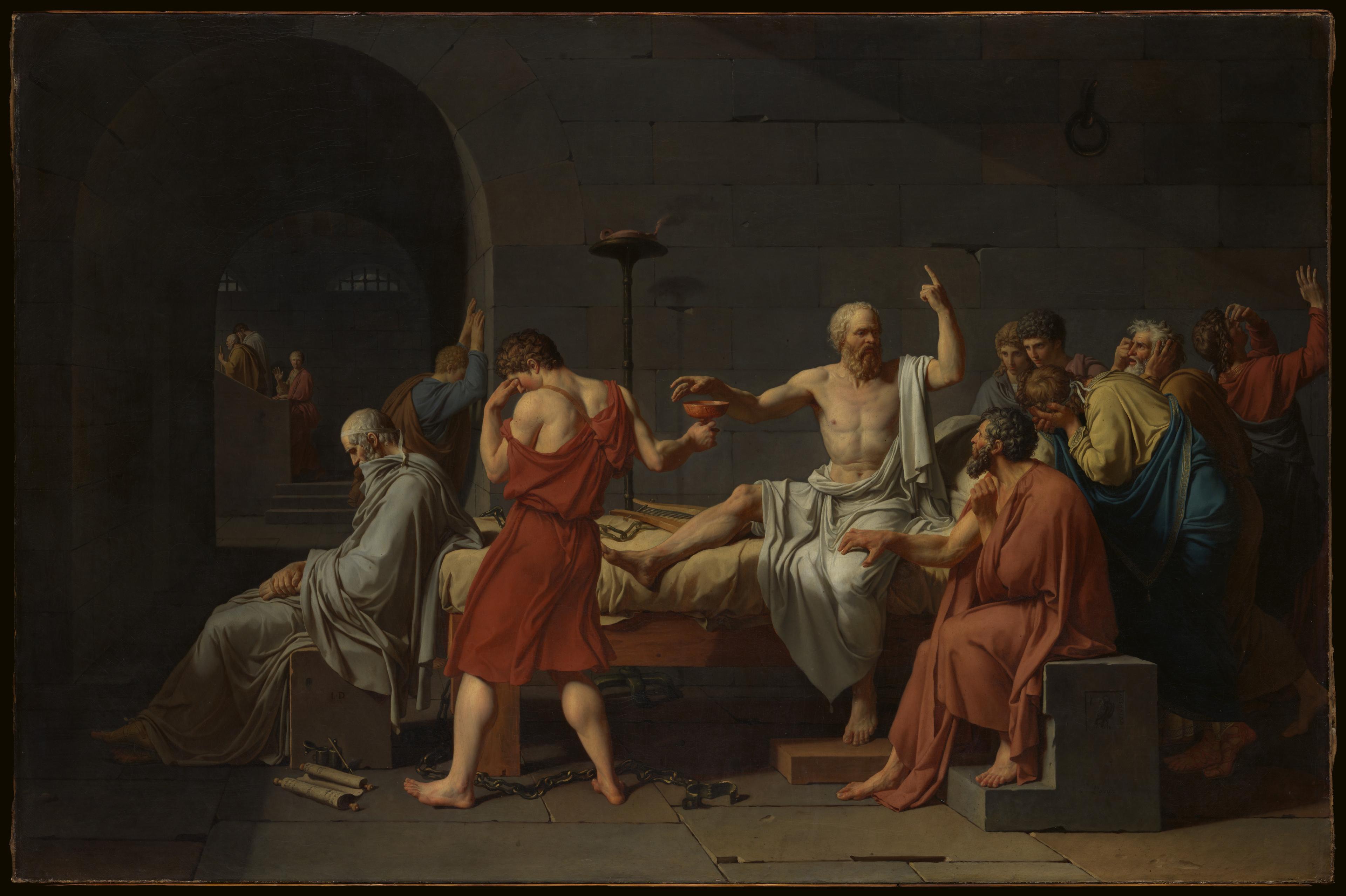
The Death of Socrates
Jacques Louis David
606 likes16 comments
Paintale uses cookies for essential site functionality and, where enabled, to serve relevant advertising via Google AdSense. You can accept all cookies or reject non-essential ones. See our Privacy Policy for details.
Now viewing
Still Life—Strawberries, Nuts, &c.
Raphaelle Peale
Period
1780-1830
Theme
Tragedy & Death
Medium
Oil on wood panel
Current Location
Art Institute of Chicago, Chicago
The Story
A member of a prominent artistic family from Maryland and Pennsylvania, Raphaelle Peale was one of the first painters in the United States to specialize in still life. In this precisely arranged composition, he meticulously rendered the various surfaces and forms of fruits, nuts, and tableware. Influenced by 17th-century Dutch still lifes, Peale featured imported material goods, such as Chinese porcelain made for the American market, a luxury item symbolizing the increasing power and prosperity of the new nation.
The large glass urn may hold strawberries grown out of season in greenhouses, called hothouses, an experiment undertaken at the family’s farm outside of Philadelphia.
Executed in Oil on wood panel, measuring 41.1 × 57.8 cm (16 3/16 × 22 3/4 in.), the surface rewards close looking. Raphaelle Peale builds the composition through layered glazes and a tightly controlled palette, letting cool shadows recede so that the warm, lit passages step forward.
Look closely and the painting opens up. Objects you might pass over — a folded letter, a half-drawn curtain, the angle of a glance — were placed to be read. Light hardens into edge, drapery becomes shroud, and the body is staged like an argument about mortality.
Art Institute of Chicago in Chicago now holds the work, where conservators and historians continue to revisit its condition and attribution. Each generation of scholarship adds a layer to how Raphaelle Peale's output from this period is understood.
“A silence so complete it becomes its own witness.”
A member of a prominent artistic family from Maryland and Pennsylvania, Raphaelle Peale was one of the first painters in the United States to specialize in still life. In this precisely arranged composition, he meticulously rendered the various surfaces and forms of fruits, nuts, and tableware. Influenced by 17th-century Dutch still lifes, Peale featured imported material goods, such as Chinese porcelain made for the American market, a luxury item symbolizing the increasing power and prosperity of the new nation. The large glass urn may hold strawberries grown out of season in greenhouses, called hothouses, an experiment undertaken at the family’s farm outside of Philadelphia.
Gift of Jamee J. and Marshall Field
Technique: oil painting, painting (image making).
Inscriptions: Signed recto, lower right, on table edge, in black paint: "Raphaelle Peale Pinsct 1822".
Mr. Feldman, Philadelphia, by 1940. James Graham and Sons Gallery, New York, by 1941. Robert C. Graham (1913–1994) and Edith Graham (1917–2003; born Edith Altschul), New York, by 1946; sold to Marshall Field V and Jamee J. Field (1947–2020; born Jamee Beckwith Jacobs), Chicago, 1982 [on loan to the Art Institute, 1982–1991]; given by them to the Art Institute of Chicago, 1991.
Art Institute of Chicago, Chicago. View on the museum’s official page.
See more works at Art Institute of Chicago or browse the full Raphaelle Peale collection.
A restrained palette and sculptural lighting create a solemn geometry. The wooden crate and letter anchor the narrative with journalistic precision.
Sources
Keep Exploring
More paintings like this
Jacques Louis David

Francisco Goya
Charles Emile Callande de Champmartin
Thomas Birch American, born England
Caravaggio
Guido Cagnacci

Sandro Botticelli

Sandro Botticelli