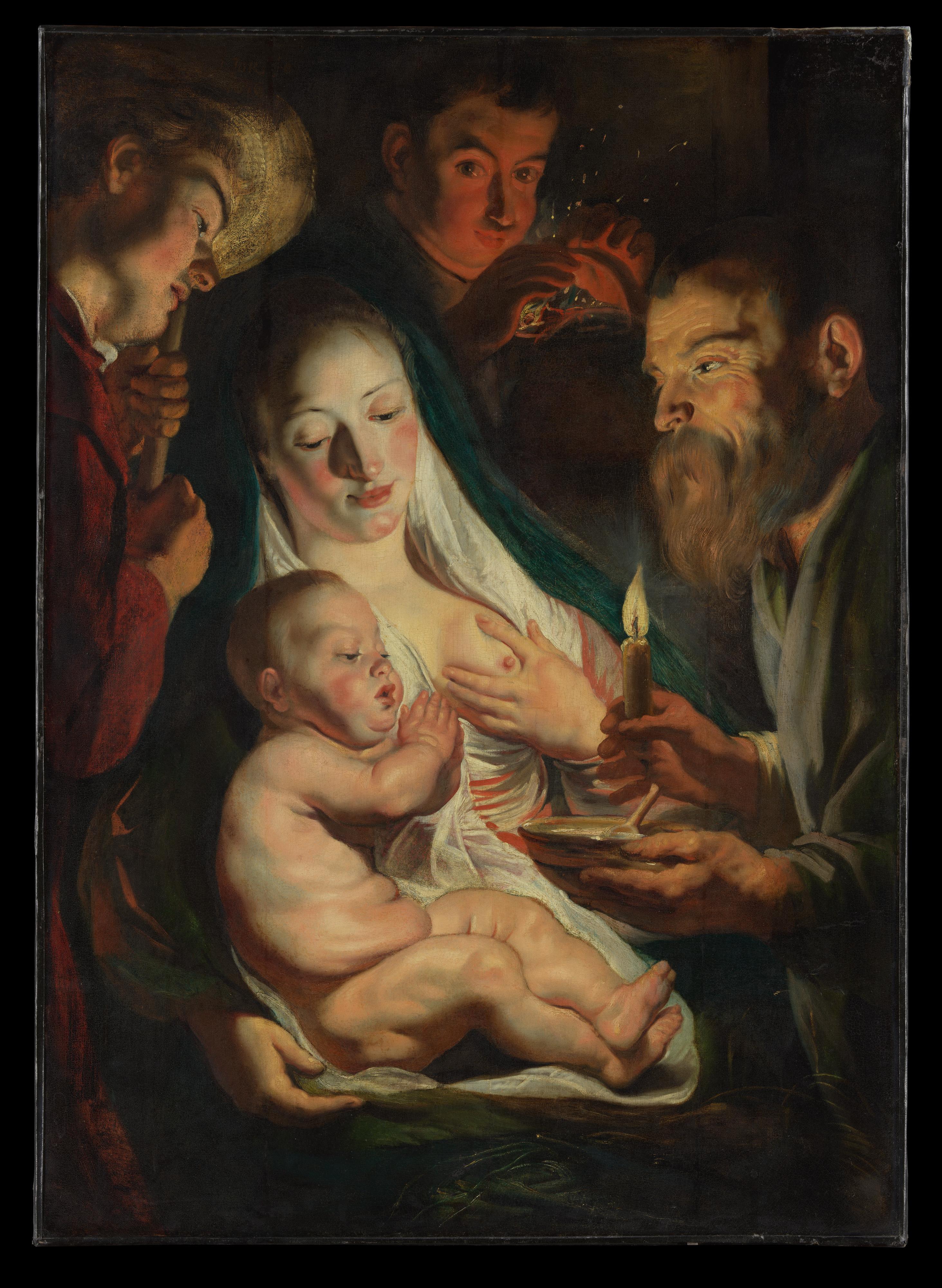
The Holy Family with Shepherds
Jacob Jordaens
558 likes128 comments
Paintale uses cookies for essential site functionality and, where enabled, to serve relevant advertising via Google AdSense. You can accept all cookies or reject non-essential ones. See our Privacy Policy for details.
Now viewing
The Temptation of the Magdalene
Jacob Jordaens
Period
1600-1650
Theme
Daily Life
Medium
Oil on panel
Current Location
Art Institute of Chicago, Chicago
The Story
In this half-length biblical painting, an aged woman offering tempting jewels—possibly the proprietor of a brothel—and an angel bestowing spiritual guidance battle for the soul of Mary Magdalene. A ghoulish demon emerges from the shadows in the background with a fistful of snakes, a menacing symbol of evil. Jacob Jordaens had already developed his own rich realism, with earthy figures and naturalistic shadows, by the time he executed this early work, probably for an upper-class home in his native Antwerp.
Created in 1611 during the 1600-1650 period, this work belongs firmly within the daily life tradition. Jacob Jordaens worked at a moment when the rivalry between Catholic Baroque drama and Protestant restraint reshaped what a painting could mean. Every gesture, fabric, and gleam of light was decoded by contemporary viewers like a private language.
Working in Oil on panel at 126.2 × 96.8 cm (49 11/16 × 38 1/4 in.); Framed: 155.6 × 130.2 × 12.7 cm (61 1/4 × 51 1/4 × 5 in.), Jacob Jordaens constructs depth through value contrast rather than outline, letting figures emerge from darkness the way they would under candlelight or through a shuttered window.
Look closely and the painting opens up. Objects you might pass over — a folded letter, a half-drawn curtain, the angle of a glance — were placed to be read. The apparent casualness is staged — objects and gestures are arranged to read as a moment caught rather than composed.
Today the painting is held by Art Institute of Chicago in Chicago, where it remains a touchstone for understanding Jacob Jordaens's contribution to Western art. It has been studied, copied, restored, and argued over for centuries — proof that great paintings keep generating new readings long after their creators have gone.
“A silence so complete it becomes its own witness.”
This painting features documented symbols with their own dedicated meaning in art history:
In this half-length biblical painting, an aged woman offering tempting jewels—possibly the proprietor of a brothel—and an angel bestowing spiritual guidance battle for the soul of Mary Magdalene. A ghoulish demon emerges from the shadows in the background with a fistful of snakes, a menacing symbol of evil. Jacob Jordaens had already developed his own rich realism, with earthy figures and naturalistic shadows, by the time he executed this early work, probably for an upper-class home in his native Antwerp.
Charles H. and Mary F. S. Worcester Collection; anonymous gift in honor of Kate and Morris Kaplan
Technique: panel painting, oil painting, painting, painting (image making), painting techniques.
Private collection, Brussels, 1928 [see Brussels 1928, no. 34]. Édouard Napoléon César Edmond Mortier, duc de Trévise (died 1946), Paris [according to Jaffé in Ottawa 1968; it was not part of his sale in Paris, May 19, 1938]. Sold, Palais des Beaux Arts, Brussels, March 12, 1951, no. 57. Morris I. Kaplan (died 1966), Chicago; offered for sale, Sotheby's , London, June 12, 1968, no. 56, bought in; heirs of Morris I. Kaplan (on loan to the Art Institute of Chicago since 1969); sold to the Art Institute, 1991.
Art Institute of Chicago, Chicago. View on the museum’s official page.
See more works at Art Institute of Chicago or browse the full Jacob Jordaens collection.
A restrained palette and sculptural lighting create a solemn geometry. The wooden crate and letter anchor the narrative with journalistic precision.
Sources
Keep Exploring
More paintings like this
Jacob Jordaens
Jacob Jordaens
Jacob Jordaens
Attributed to Peter Paul Rubens
Pieter Claesz
Frans Snyders
Pietro della Vecchia
Pieter de Neyn