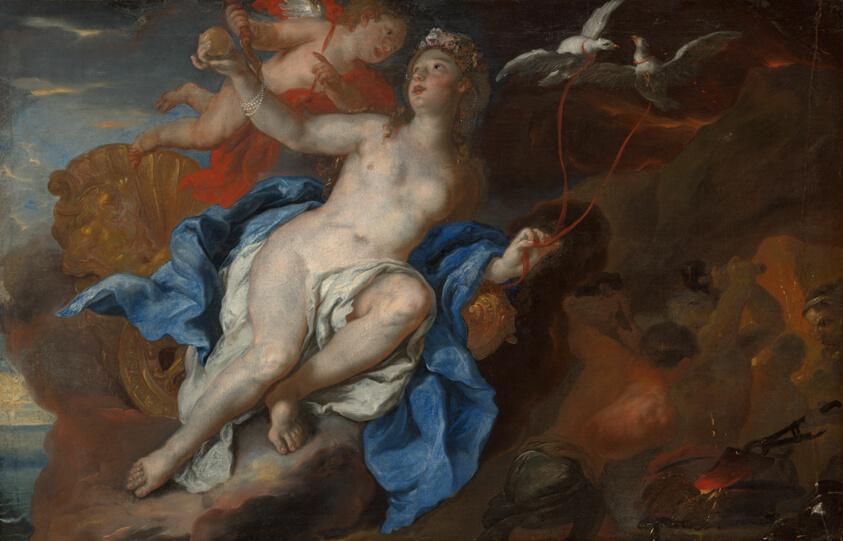
Venus and Cupid at the Forge of Vulcan
Johann Michael Rottmayr
523 likes53 comments
Paintale uses cookies for essential site functionality and, where enabled, to serve relevant advertising via Google AdSense. You can accept all cookies or reject non-essential ones. See our Privacy Policy for details.
Now viewing
Old Man Lighting a Pipe
Johann Carl Loth
Period
1650-1700
Theme
Love & Romance
Medium
Oil on canvas
Current Location
Art Institute of Chicago, Chicago
The Story
This man’s suntanned skin, worn clothing, and rustic surroundings are rendered in shades of brown that mirror the contents of his pipe. The Spanish introduced tobacco into Northern Europe in the 16th century, and smoking quickly became a beloved pastime that was widely considered healthful and nourishing. By the early 17th century, single-figure images of smokers emerged as a subgenre of Dutch and Flemish painting.
The theme posed an enticing challenge for artists, with its burning leaves, billowing plumes of smoke, and active facial expressions—here, the figure purses his lips and wrinkles his brow as he concentrates on lighting the pipe. German painter Johann Carl Loth blended the Northern emphasis on capturing textures with the dramatic illumination reminiscent of so-called Caravaggesque painters like Hendrick Terbrugghen.
Working in Oil on canvas at 95 × 85 cm (37 1/2 × 33 1/2 in.); Framed: 119.4 × 109.9 × 7 cm (47 × 43 1/4 × 2 3/4 in.), Johann Carl Loth constructs depth through value contrast rather than outline, letting figures emerge from darkness the way they would under candlelight or through a shuttered window.
Look closely and the painting opens up. Objects you might pass over — a folded letter, a half-drawn curtain, the angle of a glance — were placed to be read. Small objects scattered through the composition — a ring, a glance, a half-open door — carry the emotional plot.
Housed at Art Institute of Chicago in Chicago, the painting has passed through the hands of collectors, dealers, and institutions before reaching public view — a provenance that is itself part of the object's story.
“A silence so complete it becomes its own witness.”
This painting features documented symbols with their own dedicated meaning in art history:
This man’s suntanned skin, worn clothing, and rustic surroundings are rendered in shades of brown that mirror the contents of his pipe. The Spanish introduced tobacco into Northern Europe in the 16th century, and smoking quickly became a beloved pastime that was widely considered healthful and nourishing. By the early 17th century, single-figure images of smokers emerged as a subgenre of Dutch and Flemish painting. The theme posed an enticing challenge for artists, with its burning leaves, billowing plumes of smoke, and active facial expressions—here, the figure purses his lips and wrinkles his brow as he concentrates on lighting the pipe. German painter Johann Carl Loth blended the Northern emphasis on capturing textures with the dramatic illumination reminiscent of so-called Caravaggesque painters like Hendrick Terbrugghen.
Purchased with funds provided by The Old Masters Society
Technique: oil painting, painting, painting (image making), painting techniques.
Possibly Antony Hoevenaar, Amsterdam; sold 15 April, 1693, no. 6, "een Italianse Toebakdrinker, konstig van [Loth] [see Gerhard Ewald, Johann Carl Loth: 1632-1698 (Amsterdam, 1965), p. 124, no. 558]." Possibly Jan Smees, Amsterdam; sold 6 April 1729, no. 4, "een Tabaks Rooker, Kragtig en kunstig geschildert door Carlotti [see Ewald 1965, p. 124, no. 559]." Christie's, London, 24 May 1985, no. 107 (ill.); Capitoline Fine Arts Ltd., Washington, D. C., 1985 to 1987; sold to The Art Institute, 1987.
Art Institute of Chicago, Chicago. View on the museum’s official page.
See more works at Art Institute of Chicago or browse the full Johann Carl Loth collection.
A restrained palette and sculptural lighting create a solemn geometry. The wooden crate and letter anchor the narrative with journalistic precision.
Sources
Keep Exploring
More paintings like this
Johann Michael Rottmayr
Caravaggio

Sandro Botticelli

Sandro Botticelli
Michele Desubleo

Hieronymus Bosch
Titian
Imitator of Titian