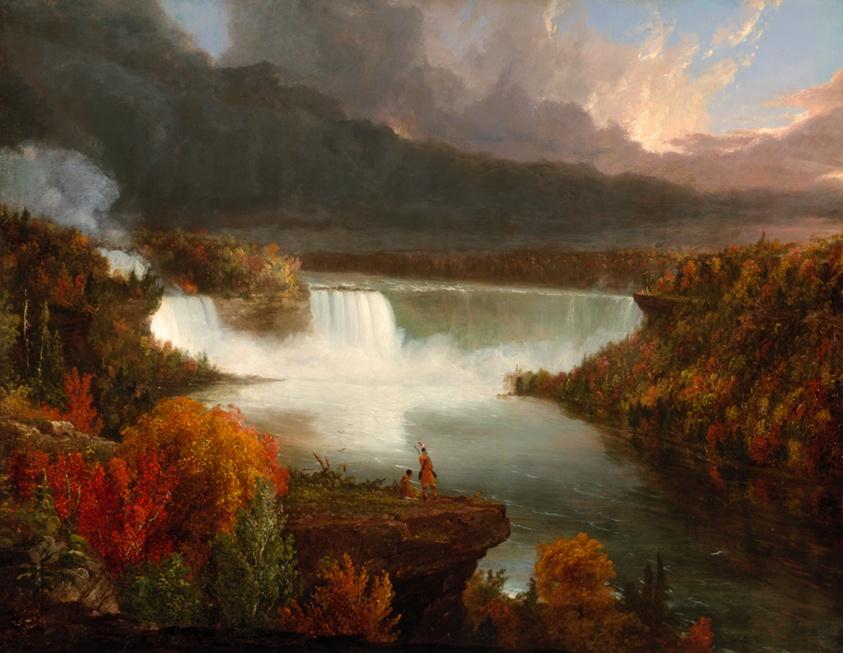
Distant View of Niagara Falls
Thomas Cole
919 likes129 comments
Paintale uses cookies for essential site functionality and, where enabled, to serve relevant advertising via Google AdSense. You can accept all cookies or reject non-essential ones. See our Privacy Policy for details.
Now viewing
New England Scenery
Thomas Cole
Period
1831-1870
Theme
Landscape
Medium
Oil on canvas
Current Location
Art Institute of Chicago, Chicago
The Story
Although Thomas Cole is best known for his scenes of the American wilderness, he also rendered pastoral vistas of cultivated landscapes. This work depicts New Hampshire’s White Mountains, an area that Cole traveled to and painted on numerous occasions, as did other 19th-century landscape artists. The prominent church spire at middle distance emphasizes the role of religion in agrarian society and the glow of the low sun expresses a sense of optimism for a rural America.
The painting conveys an ideal that was increasingly far from reality, however, as the United States was then being transformed by rapid urbanization and the Industrial Revolution.
The physical object — Oil on canvas, 57.1 × 46.7 cm (22 1/2 × 18 3/8 in.) — carries its own history of handling and restoration. Thomas Cole's brushwork here moves between exacting description and looser, more suggestive passages, a balance typical of 19th-century American studio practice.
Look closely and the painting opens up. Objects you might pass over — a folded letter, a half-drawn curtain, the angle of a glance — were placed to be read. The scale is the argument: a single, tiny figure against sky and rock does the work of describing nature as something larger than any human claim on it.
Art Institute of Chicago in Chicago now holds the work, where conservators and historians continue to revisit its condition and attribution. Each generation of scholarship adds a layer to how Thomas Cole's output from this period is understood.
“A silence so complete it becomes its own witness.”
Although Thomas Cole is best known for his scenes of the American wilderness, he also rendered pastoral vistas of cultivated landscapes. This work depicts New Hampshire’s White Mountains, an area that Cole traveled to and painted on numerous occasions, as did other 19th-century landscape artists. The prominent church spire at middle distance emphasizes the role of religion in agrarian society and the glow of the low sun expresses a sense of optimism for a rural America. The painting conveys an ideal that was increasingly far from reality, however, as the United States was then being transformed by rapid urbanization and the Industrial Revolution.
Nickerson Collection
Inscriptions: Signed on lower section of tree trunk: "T Cole" Dated at bottom, left of center: "1839".
Thomas Cole, from 1839; W.F. Ladd, New York, around 1841; Charles Baker, New York, by 1853; Samuel Nickerson, Chicago, 1876; given to the Art Institute of Chicago, 1900.
Art Institute of Chicago, Chicago. View on the museum’s official page.
See more works at Art Institute of Chicago or browse the full Thomas Cole collection.
A restrained palette and sculptural lighting create a solemn geometry. The wooden crate and letter anchor the narrative with journalistic precision.
Sources
Keep Exploring
More paintings like this
Thomas Cole
Théodore Rousseau
Théodore Rousseau
Jasper Francis Cropsey
Jasper Francis Cropsey American
Asher B. Durand American
Sanford Robinson Gifford
Thomas Doughty American