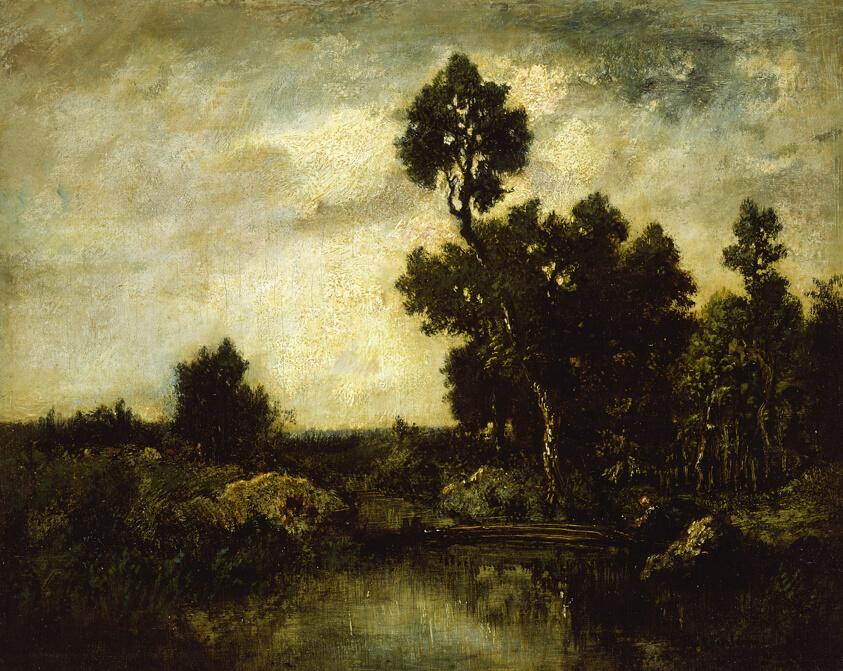
Landscape
Théodore Rousseau
1346 likes76 comments
Paintale uses cookies for essential site functionality and, where enabled, to serve relevant advertising via Google AdSense. You can accept all cookies or reject non-essential ones. See our Privacy Policy for details.
Now viewing
Blasted Tree
Jasper Francis Cropsey
Period
1831-1870
Theme
Landscape
Medium
Oil on canvas
Current Location
Art Institute of Chicago, Chicago
The Story
Like his fellow Hudson River School landscapists, Jasper Cropsey sketched in nature and then combined motifs he had observed into his compositions in his New York studio. In the late 1840s and early 1850s he traveled frequently to the Catskills, where he produced this oil sketch. Here, the gnarled trunk and branches of the weather-beaten tree offered the artist interesting variations of color, tone, and line. Cropsey often included such old trees in his paintings in emulation of Thomas Cole, whom he greatly admired.
In Cropsey’s work, as in that of Cole, the subject introduces a sense of time and history into the scene, as well as conveying the sublime power of nature.
As Oil on canvas (43.2 × 35.6 cm (17 × 14 in.)), the work shows the tool marks and layering choices typical of Jasper Francis Cropsey's output in this period — decisions about ground, underpainting, and glaze that a photograph can only partly convey.
Look closely and the painting opens up. Objects you might pass over — a folded letter, a half-drawn curtain, the angle of a glance — were placed to be read. Weather and light are the real subject — the artist is tracking a specific, fleeting atmospheric moment rather than an idealized, generic view.
Today the painting is held by Art Institute of Chicago in Chicago, where it remains a touchstone for understanding Jasper Francis Cropsey's contribution to Western art. It has been studied, copied, restored, and argued over for centuries — proof that great paintings keep generating new readings long after their creators have gone.
“A silence so complete it becomes its own witness.”
Like his fellow Hudson River School landscapists, Jasper Cropsey sketched in nature and then combined motifs he had observed into his compositions in his New York studio. In the late 1840s and early 1850s he traveled frequently to the Catskills, where he produced this oil sketch. Here, the gnarled trunk and branches of the weather-beaten tree offered the artist interesting variations of color, tone, and line. Cropsey often included such old trees in his paintings in emulation of Thomas Cole, whom he greatly admired. In Cropsey’s work, as in that of Cole, the subject introduces a sense of time and history into the scene, as well as conveying the sublime power of nature.
Gift of Jamee J. and Marshall Field
Kennedy Galleries, New York; Marshall Field V and Jamee J. Field (1947–2020; born Jamee Beckwith Jacobs), Chicago, by 1997; given to the Art Institute of Chicago, 1997.
Art Institute of Chicago, Chicago. View on the museum’s official page.
See more works at Art Institute of Chicago or browse the full Jasper Francis Cropsey collection.
A restrained palette and sculptural lighting create a solemn geometry. The wooden crate and letter anchor the narrative with journalistic precision.
Sources
Keep Exploring
More paintings like this
Théodore Rousseau
Théodore Rousseau
Jasper Francis Cropsey American
Asher B. Durand American
Sanford Robinson Gifford
Thomas Cole
Thomas Doughty American
Albert Bierstadt