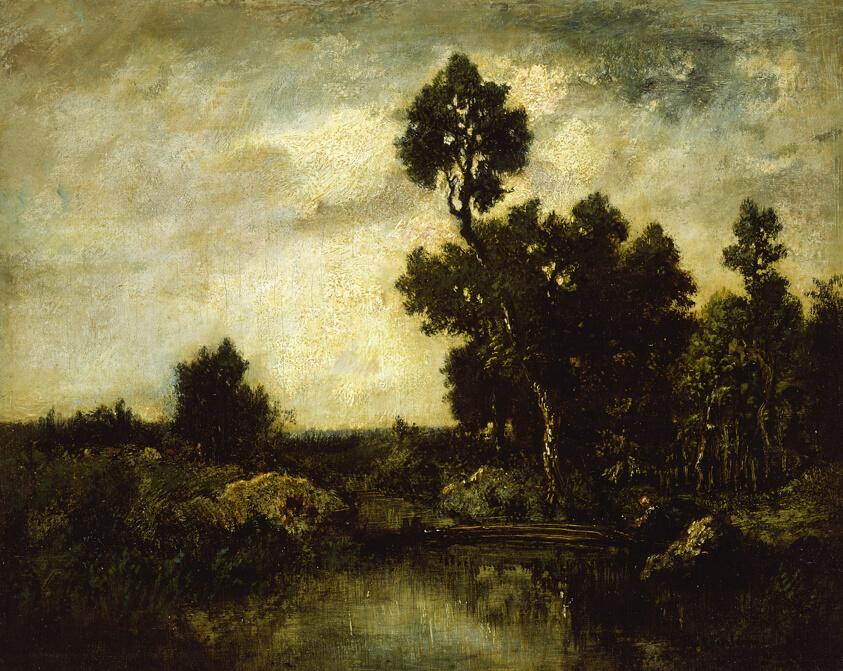
Landscape
Théodore Rousseau
1346 likes76 comments
Paintale uses cookies for essential site functionality and, where enabled, to serve relevant advertising via Google AdSense. You can accept all cookies or reject non-essential ones. See our Privacy Policy for details.
Now viewing
Mountain Brook
Albert Bierstadt
Period
1831-1870
Theme
Landscape
Medium
Oil on canvas
Current Location
Art Institute of Chicago, Chicago
The Story
Albert Bierstadt is best remembered for his paintings of the American West, but during his early career, the ambitious artist also created New England landscapes, particularly of the White Mountains, as seen here. When this painting was first exhibited in 1863, critics declared it Bierstadt’s “best work” and praised the artist’s deft contrast of “light and shade,” which brought a heightened realism to the image.
Bierstadt’s affinity for the White Mountains mirrored a growing interest in the region as one of America’s premier tourist attractions. Photographs of the area from the 19th century suggest that Bierstadt utilized landscape elements from the Flume, a popular New Hampshire tourist site, in this imaginary composition.
Executed in Oil on canvas, measuring 111.8 × 91.4 cm (44 × 36 in.), the surface rewards close looking. Albert Bierstadt builds the composition through layered glazes and a tightly controlled palette, letting cool shadows recede so that the warm, lit passages step forward.
Look closely and the painting opens up. Objects you might pass over — a folded letter, a half-drawn curtain, the angle of a glance — were placed to be read. The scale is the argument: a single, tiny figure against sky and rock does the work of describing nature as something larger than any human claim on it.
Today the painting is held by Art Institute of Chicago in Chicago, where it remains a touchstone for understanding Albert Bierstadt's contribution to Western art. It has been studied, copied, restored, and argued over for centuries — proof that great paintings keep generating new readings long after their creators have gone.
“A silence so complete it becomes its own witness.”
This painting features documented symbols with their own dedicated meaning in art history:
Albert Bierstadt is best remembered for his paintings of the American West, but during his early career, the ambitious artist also created New England landscapes, particularly of the White Mountains, as seen here. When this painting was first exhibited in 1863, critics declared it Bierstadt’s “best work” and praised the artist’s deft contrast of “light and shade,” which brought a heightened realism to the image. Bierstadt’s affinity for the White Mountains mirrored a growing interest in the region as one of America’s premier tourist attractions. Photographs of the area from the 19th century suggest that Bierstadt utilized landscape elements from the Flume, a popular New Hampshire tourist site, in this imaginary composition.
Purchased with funds provided by Mrs. Herbert A. Vance; fund of an anonymous donor; Wesley M. Dixon Jr. Fund and Endowment; Henry Horner Straus and Mr. and Mrs. Frederick G. Wacker Jr. endowment funds; through prior acquisitions of various donors, including Samuel P. Avery Endowment, Mrs. George A. Carpenter, Frederick S. Colburn, Mr. and Mrs. Stanley Feinberg, Field Museum of Natural History, Mr. and Mrs. Frank Harding, International Minerals and Chemicals Corp., Mr. and Mrs. Ralph Loeff, Mrs. Frank C. Miller, Mahlan D. Moulds, Mrs. Clive Runnells, Mr. and Mrs. Stanley Stone, and the Charles H. and Mary F.S. Worcester Collection
Inscriptions: Signed, lower left: "A. Bierstadt".
Oliver Kelly, Ohio, before 1900; by descent in the family until 1989; Hirschl and Adler Galleries, New York; Private collection, Los Angeles; Michael N. Altman and Company, New York, by 1997; the Art Institute of Chicago,1997.
Art Institute of Chicago, Chicago. View on the museum’s official page.
See more works at Art Institute of Chicago or browse the full Albert Bierstadt collection.
A restrained palette and sculptural lighting create a solemn geometry. The wooden crate and letter anchor the narrative with journalistic precision.
Sources
Keep Exploring
More paintings like this
Théodore Rousseau
Théodore Rousseau
Jasper Francis Cropsey
Jasper Francis Cropsey American
Asher B. Durand American
Sanford Robinson Gifford
Thomas Cole
Thomas Doughty American