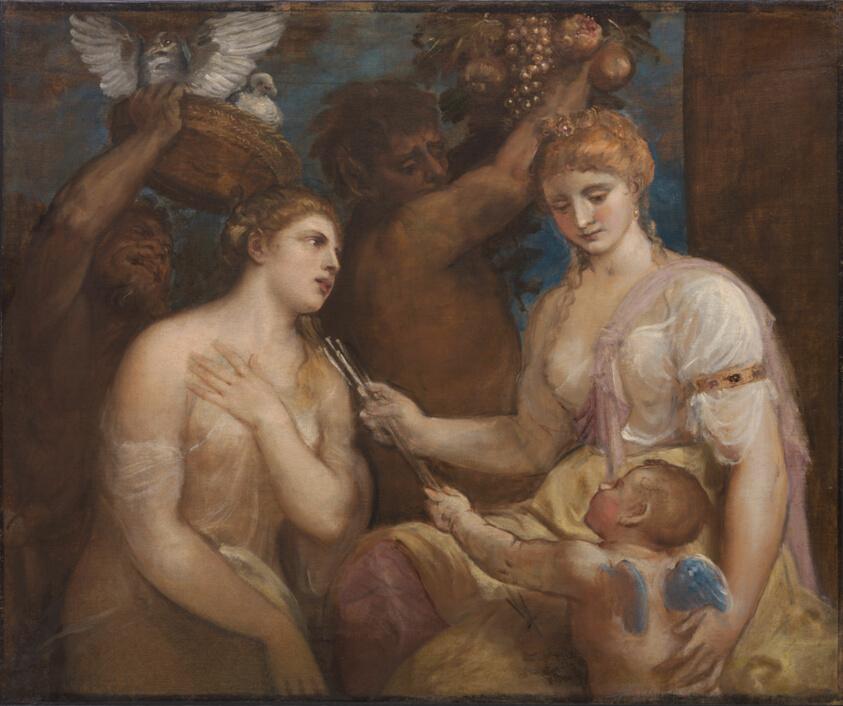
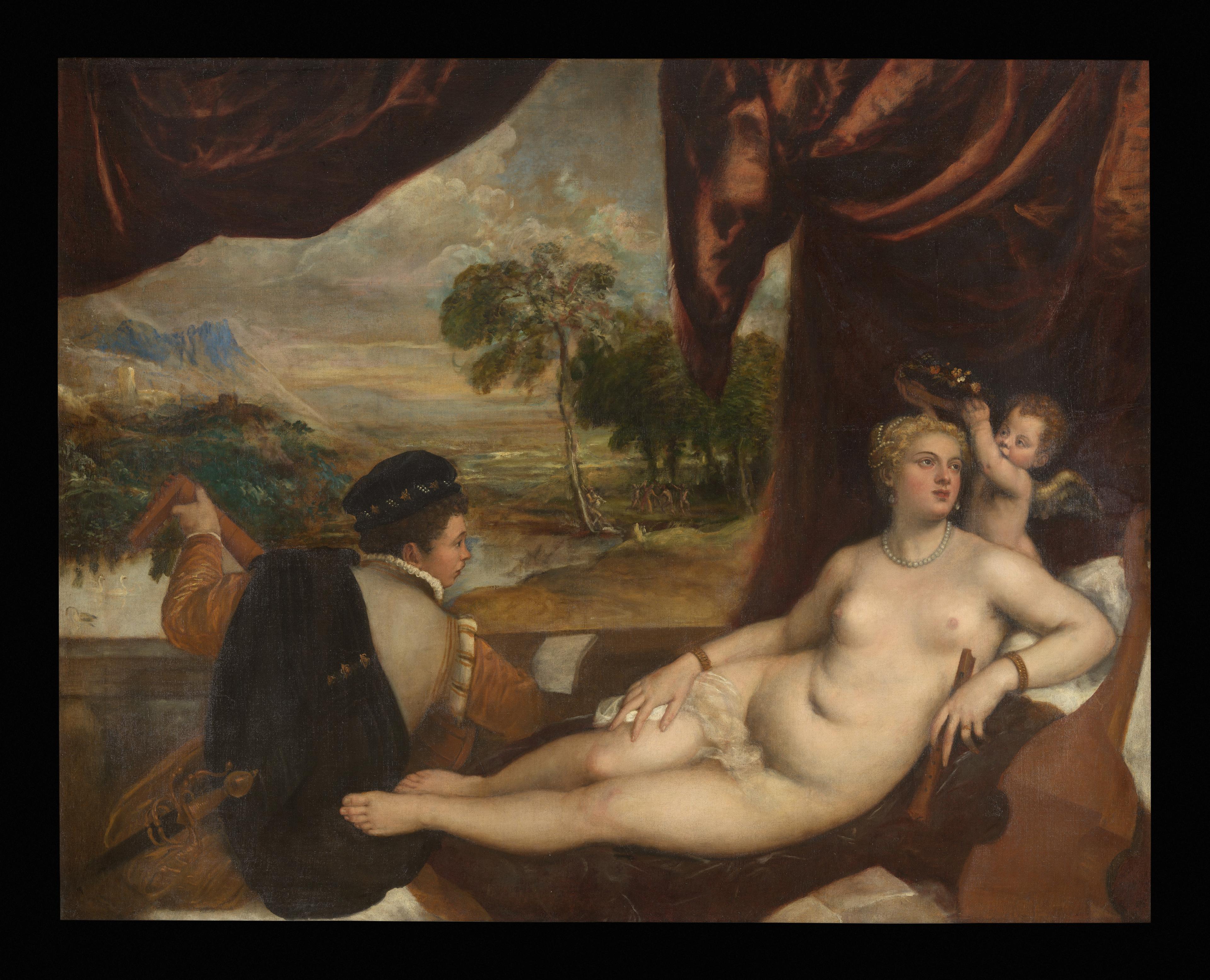
Allegory of Venus and Cupid
Imitator of Titian
592 likes22 comments
Paintale uses cookies for essential site functionality and, where enabled, to serve relevant advertising via Google AdSense. You can accept all cookies or reject non-essential ones. See our Privacy Policy for details.
Now viewing
Venus and Mars with Cupid and the Three Graces in a Landscape
Domenico Tintoretto
Period
1550-1600
Theme
Love & Romance
Medium
Oil on canvas
Current Location
Art Institute of Chicago, Chicago
The Story
Venus and Mars with Cupid and the Three Graces in a Landscape is one of the most evocative works by Domenico Tintoretto, painted around 1585. The canvas distills the obsessions of the 1550-1600 era — patrons, faith, power, and the fragile theatre of human emotion — into a single, charged image.
Created in 1585 during the 1550-1600 period, this work belongs firmly within the love & romance tradition. Domenico Tintoretto worked at a moment when the rediscovery of classical antiquity reshaped what a painting could mean. Every gesture, fabric, and gleam of light was decoded by contemporary viewers like a private language.
Executed in Oil on canvas, measuring 106.5 × 142.8 cm (41 7/8 × 56 1/4 in.), the surface rewards close looking. Domenico Tintoretto builds the composition through layered glazes and a tightly controlled palette, letting cool shadows recede so that the warm, lit passages step forward.
Look closely and the painting opens up. Objects you might pass over — a folded letter, a half-drawn curtain, the angle of a glance — were placed to be read. The scene trades in a shared visual shorthand for courtship and longing that period audiences would have decoded instantly.
Today the painting is held by Art Institute of Chicago in Chicago, where it remains a touchstone for understanding Domenico Tintoretto's contribution to Western art. It has been studied, copied, restored, and argued over for centuries — proof that great paintings keep generating new readings long after their creators have gone.
“A silence so complete it becomes its own witness.”
Charles H. and Mary F. S. Worcester Collection
Technique: oil painting, painting techniques, painting (image making), painting.
Don Gaspar Méndez de Haro y Guzmán, Marqués del Carpio y Helice and viceroy of Naples (died 1687), by 1682/3 [his monogram, DGH / 4,67 / 1406, was painted on the reverse of the old lining canvas; the painting is no. 465 [sic] in the 1682/83 inventory of the Carpio collection, Rome, as “Un quadro che rappresenta Venere sopra un Letto, che vede Amore che ha gl’ occhi bendati, e da Lontano Le tre Gratie nude di mano di Domenicao Tintoretto”, and no. 1406 in the 1687 inventory of the same collection, taken in Naples, see Burke and Cherry 1997]; probably by descent to the Alba collection through Don Gaspar’s daughter, Doña Catalina, who in 1688 married the tenth Duke of Alba [the painting is not included in the inventories of the Alba Collection, which are incomplete; for these inventories see A. M. de Barcia, Catálogo de la colección…del…Duque de Berwick y de Alba (Madrid, 1911)]. Price collection, London, nineteenth or early twentieth century, as Jacopo Tintoretto [reference appears on the mount of a photograph of the painting in the Witt Library in London; this location and the following does not necessarily precede its presence in the H. M. Clark collection]. Dowdeswell and Dowdeswell, London, as Jacopo Tintoretto [according to the Witt Library mount cited above]. H. M. Clark, London, as Jacopo Tintoretto [according to registrar’s records]. D. Heinemann, Munich; sold by Heinemann to Charles H. Worcester, 1928, as Jacopo Tintoretto [according to registrar’s records]; Charles H. Worcester, Chicago, 1928–29; on loan to the Art Institute from 1928; given to the Art Institute, 1929.
Art Institute of Chicago, Chicago. View on the museum’s official page.
See more works at Art Institute of Chicago or browse the full Domenico Tintoretto collection.
A restrained palette and sculptural lighting create a solemn geometry. The wooden crate and letter anchor the narrative with journalistic precision.
Sources
Keep Exploring
More paintings like this
Imitator of Titian
Luca Cambiaso
Caravaggio

Sandro Botticelli

Sandro Botticelli
Michele Desubleo

Hieronymus Bosch
Titian