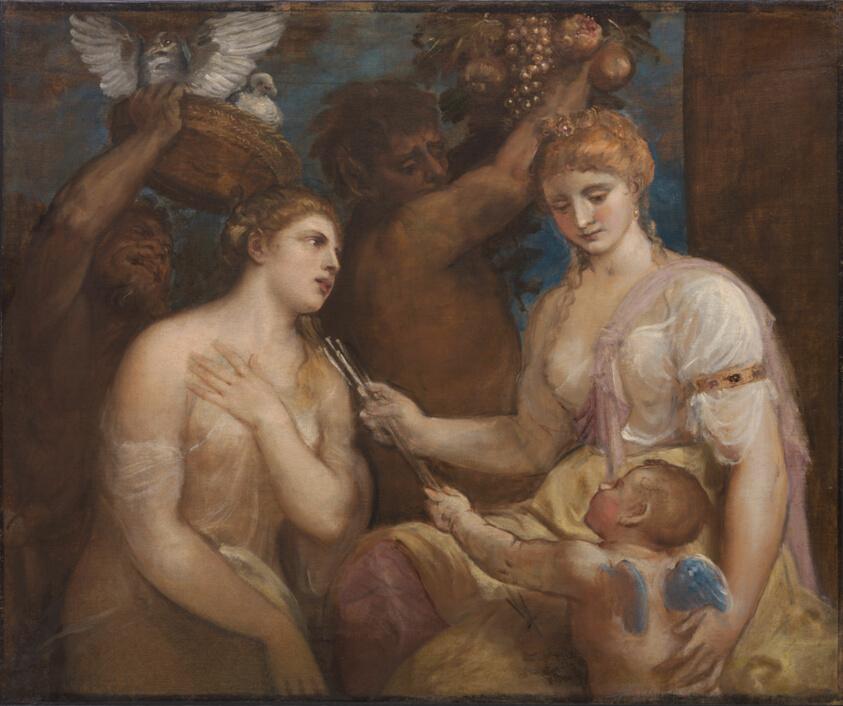
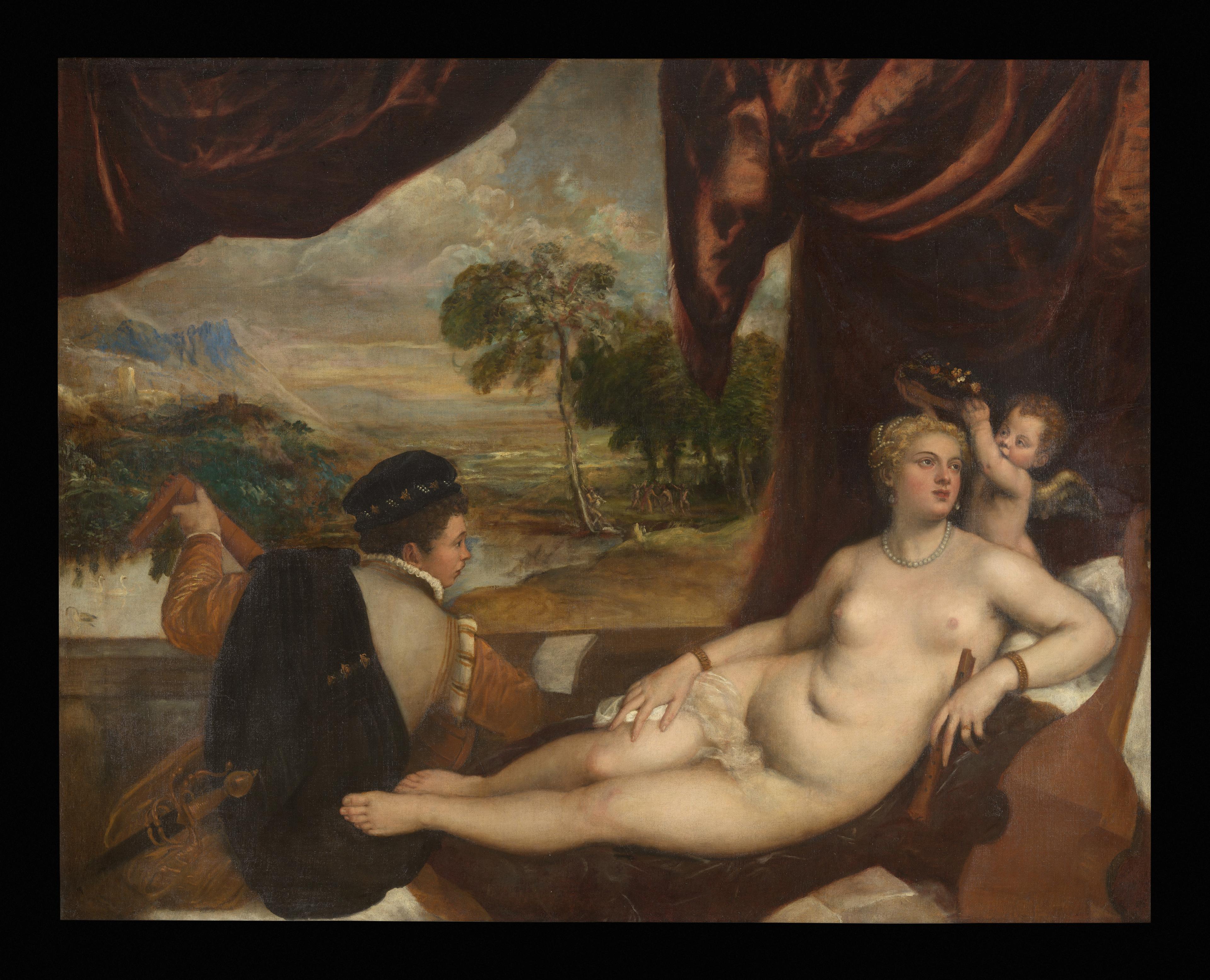
Allegory of Venus and Cupid
Imitator of Titian
592 likes22 comments
Paintale uses cookies for essential site functionality and, where enabled, to serve relevant advertising via Google AdSense. You can accept all cookies or reject non-essential ones. See our Privacy Policy for details.
Now viewing
Venus and Cupid
Luca Cambiaso
Period
1550-1600
Theme
Love & Romance
Medium
Oil on canvas
Current Location
Art Institute of Chicago, Chicago
The Story
The canopied bed and profile view lend an unusual intimacy to this representation of the Roman goddess of love and her son. The doves in the lower-left corner are an emblem of Venus; the discarded quiver with an unbuckled strap indicates that she has disarmed Cupid, who was notorious for wounding lovers with his arrows. The most important and inventive painter in 16th-century Genoa, Luca Cambiaso developed a highly personal style characterized by geometric simplification of anatomy and dramatic, often silvery light.
Created in 1565 during the 1550-1600 period, this work belongs firmly within the love & romance tradition. Luca Cambiaso worked at a moment when the rediscovery of classical antiquity reshaped what a painting could mean. Every gesture, fabric, and gleam of light was decoded by contemporary viewers like a private language.
Executed in Oil on canvas, measuring 107.5 × 95.7 cm (42 3/8 × 37 5/8 in.); Framed: 138.5 × 126.7 × 8.6 cm (54 1/2 × 49 7/8 × 3 3/8 in.), the surface rewards close looking. Luca Cambiaso builds the composition through layered glazes and a tightly controlled palette, letting cool shadows recede so that the warm, lit passages step forward.
Look closely and the painting opens up. Objects you might pass over — a folded letter, a half-drawn curtain, the angle of a glance — were placed to be read. Small objects scattered through the composition — a ring, a glance, a half-open door — carry the emotional plot.
Art Institute of Chicago in Chicago now holds the work, where conservators and historians continue to revisit its condition and attribution. Each generation of scholarship adds a layer to how Luca Cambiaso's output from this period is understood.
“A silence so complete it becomes its own witness.”
The canopied bed and profile view lend an unusual intimacy to this representation of the Roman goddess of love and her son. The doves in the lower-left corner are an emblem of Venus; the discarded quiver with an unbuckled strap indicates that she has disarmed Cupid, who was notorious for wounding lovers with his arrows. The most important and inventive painter in 16th-century Genoa, Luca Cambiaso developed a highly personal style characterized by geometric simplification of anatomy and dramatic, often silvery light.
A. A. Munger Collection
Technique: oil painting, painting, painting (image making), painting techniques.
William Patoun (d. 1782), Richmond, Surrey; sold by Patoun to Sir Abraham Hume, Bt. (d. 1838), Wormley Bury, Hertfordshire, by 1782 [see Hume 1824]; by descent to his grandson John Hume Egerton, Viscount Alford (d. 1851), Ashridge Park, Berkhamsted, 1838–51 [according to List of Paintings and Pictures settled by Sir Abraham Hume, Bart. as Heirlooms contained in a Deed of Settlement dated the 27th February, 1834, no. 36, typescript copy, London, National Gallery Library.]; by descent to Adelbert Salusbury Cockayne Cust, fifth Baron Brownlow, 1867–1927; sold Christie’s London, May 4, 1923, no. 109, to Collings for 12 gns [according to an annotated copy of the sale catalogue at Christie’s, London]. Private Collection, Italy [according to Sweet 1943]. William E. Suida, Baden, near Vienna, and New York, by 1927 to 1941 [see Genoa 1956 exhibition, and Suida Manning and Suida 1958]. Sold by A.F. Mondschein, New York, to the Art Institute, 1942.
Art Institute of Chicago, Chicago. View on the museum’s official page.
See more works at Art Institute of Chicago or browse the full Luca Cambiaso collection.
A restrained palette and sculptural lighting create a solemn geometry. The wooden crate and letter anchor the narrative with journalistic precision.
Sources
Keep Exploring
More paintings like this
Imitator of Titian
Domenico Tintoretto
Caravaggio

Sandro Botticelli

Sandro Botticelli
Michele Desubleo

Hieronymus Bosch
Titian