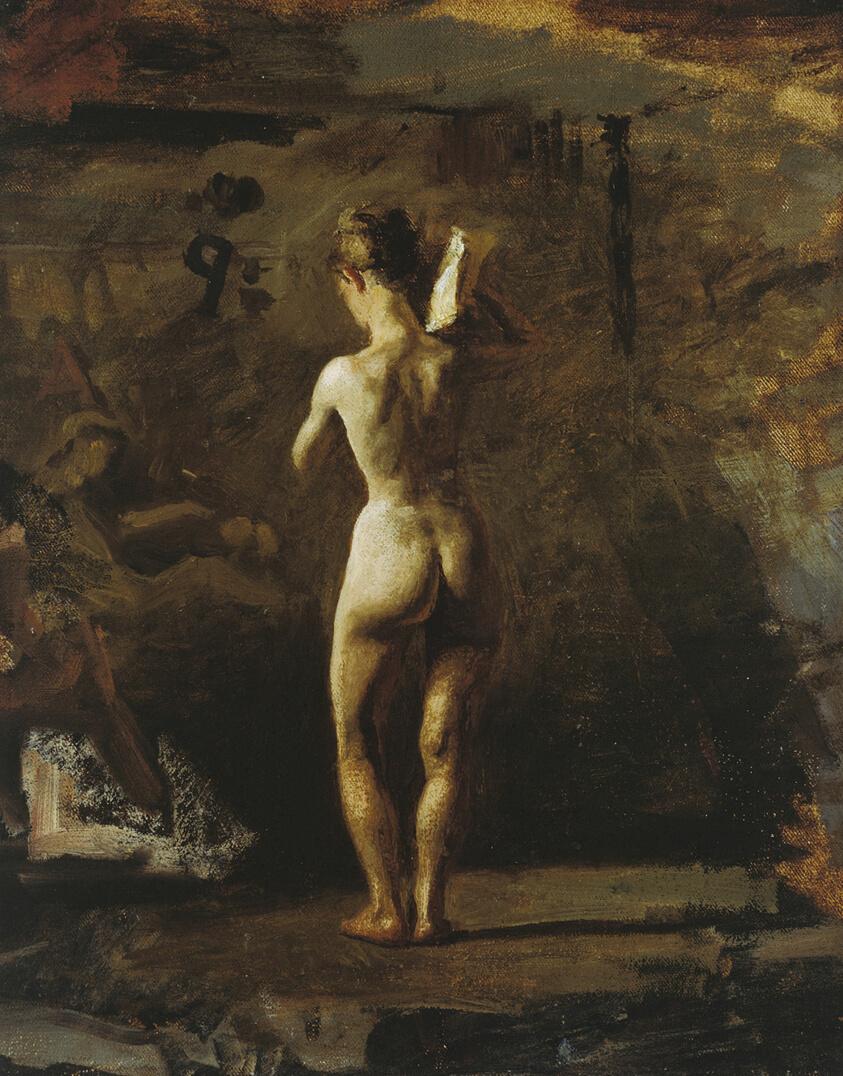
Study for "William Rush Carving His Allegorical Figure of the Schuylkill River"
Thomas Eakins
1096 likes46 comments
Paintale uses cookies for essential site functionality and, where enabled, to serve relevant advertising via Google AdSense. You can accept all cookies or reject non-essential ones. See our Privacy Policy for details.
Now viewing
Portrait of Mary Adeline Williams
Thomas Eakins
Period
1871-1900
Theme
Portrait
Medium
Oil on canvas
Current Location
Art Institute of Chicago, Chicago
The Story
Portrait of Mary Adeline Williams is the title given to two separate oil on canvas paintings by Thomas Eakins, each depicting Mary Adeline Williams (1853–1941), known familiarly to the Eakins family as "Addie". The first painting, now in the Art Institute of Chicago, was completed in 1899, and portrays the subject with a serious demeanor. The second portrait, in the Philadelphia Museum of Art, was painted in 1900, and is more emotionally expressive.
Created in 1899, this work belongs firmly within the portrait tradition of American painting. Thomas Eakins worked at a moment when the young republic was still deciding what its own art should look like — how much to borrow from Europe, how much to invent from its own landscape and daily life. Every gesture, fabric, and gleam of light was pitched at an audience learning to take American subjects seriously.
Executed in Oil on canvas, measuring 61 × 50.8 cm (24 × 20 1/16 in.), the surface rewards close looking. Thomas Eakins builds the composition through layered glazes and a tightly controlled palette, letting cool shadows recede so that the warm, lit passages step forward.
Look closely and the painting opens up. Objects you might pass over — a folded letter, a half-drawn curtain, the angle of a glance — were placed to be read. Every prop in a portrait like this is a decision — jewelry, fabric, and hand position were negotiated between painter and patron to shape how the sitter would be remembered.
Today the painting is held by Art Institute of Chicago in Chicago, where it remains a touchstone for understanding Thomas Eakins's contribution to Western art. It has been studied, copied, restored, and argued over for centuries — proof that great paintings keep generating new readings long after their creators have gone.
“A silence so complete it becomes its own witness.”
Thomas Eakins aimed to paint the human figure with uncompromising realism, executing likenesses that focus on introspection and psychological depth. A family friend, Mary Adeline Williams sat for this portrait in 1899, a year before she would move into the Philadelphia home of Eakins and his wife, artist Susan MacDowell Eakins. Although the composition presents Addie (as she was known) as straight-laced and severe, she was described by Susan Eakins as active and engaged—riding bicycles, going to art exhibitions, and socializing between the sittings for this work.
Friends of American Art Collection
The artist, Philadelphia; by descent to his estate and to Susan Macdowell Eakins (1851–1938), Philadelphia, 1916; sold to Babcock Galleries, New York, 1939; sold to the Art Institute of Chicago, 1939.
Art Institute of Chicago, Chicago. View on the museum’s official page.
See more works at Art Institute of Chicago or browse the full Thomas Eakins collection.
A restrained palette and sculptural lighting create a solemn geometry. The wooden crate and letter anchor the narrative with journalistic precision.
Sources
Keep Exploring
More paintings like this
Thomas Eakins

Thomas Eakins
Vincent van Gogh
Martin Johnson Heade
John Singer Sargent
John Singer Sargent
Albert Besnard
John Singer Sargent