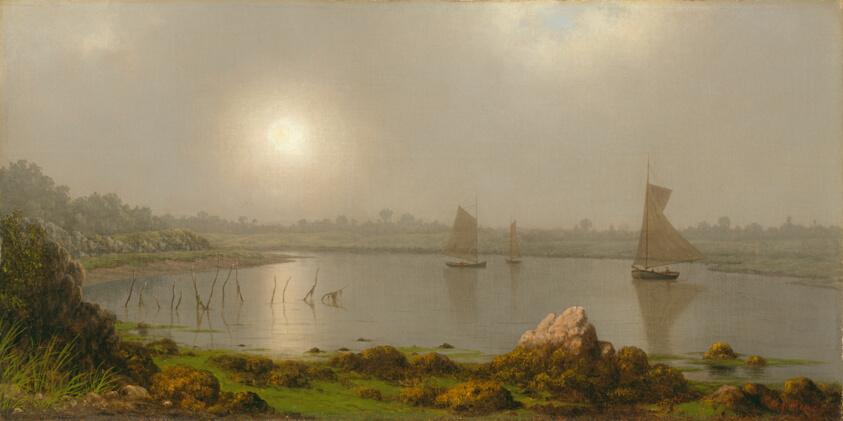
York Harbor, Coast of Maine
Martin Johnson Heade
608 likes118 comments
Paintale uses cookies for essential site functionality and, where enabled, to serve relevant advertising via Google AdSense. You can accept all cookies or reject non-essential ones. See our Privacy Policy for details.
Now viewing
Magnolias on Light Blue Velvet Cloth
Martin Johnson Heade
Period
1871-1900
Theme
Portrait
Medium
Oil on canvas
Current Location
Art Institute of Chicago, Chicago
The Story
This sensuous and decorative image dates from the later part of Martin Johnson Heade’s long, varied, and peripatetic career. Traveling through much of the United States, to England and continental Europe, and (three different times) to Brazil, he produced work ranging from pristine views of East Coast salt marshes and lush tropical landscapes to pictures of exotic hummingbirds and orchids. At the age of sixty-four, Heade settled in Saint Augustine, Florida.
There he began painting detailed arrangements of native flowers, including the Cherokee rose, orange blossom, and magnolia. Stretched out like an odalisque on blue velvet cloth, the curvaceous magnolia was meticulously rendered in pale, subtle hues and illuminated by a light so sharp that the image evokes the hyperintensity of a dream. The warm, steamy atmosphere is almost palpable, as is the blossom’s heady, pungent scent.
As Oil on canvas (38.6 × 61.8 cm (15 1/4 × 24 3/8 in.)), the work shows the tool marks and layering choices typical of Martin Johnson Heade's output in this period — decisions about ground, underpainting, and glaze that a photograph can only partly convey.
Look closely and the painting opens up. Objects you might pass over — a folded letter, a half-drawn curtain, the angle of a glance — were placed to be read. Likeness was only part of the job; the painting also had to argue for the sitter's place in the world.
Art Institute of Chicago in Chicago now holds the work, where conservators and historians continue to revisit its condition and attribution. Each generation of scholarship adds a layer to how Martin Johnson Heade's output from this period is understood.
“A silence so complete it becomes its own witness.”
This painting features documented symbols with their own dedicated meaning in art history:
This sensuous and decorative image dates from the later part of Martin Johnson Heade’s long, varied, and peripatetic career. Traveling through much of the United States, to England and continental Europe, and (three different times) to Brazil, he produced work ranging from pristine views of East Coast salt marshes and lush tropical landscapes to pictures of exotic hummingbirds and orchids. At the age of sixty-four, Heade settled in Saint Augustine, Florida. There he began painting detailed arrangements of native flowers, including the Cherokee rose, orange blossom, and magnolia. Stretched out like an odalisque on blue velvet cloth, the curvaceous magnolia was meticulously rendered in pale, subtle hues and illuminated by a light so sharp that the image evokes the hyperintensity of a dream. The warm, steamy atmosphere is almost palpable, as is the blossom’s heady, pungent scent. The Art Institute’s Magnolias is one of a number of compositions by the artist featuring this dramatic yet delicate white flower.
Purchased with funds provided by Gloria and Richard Manney; Harold L. Stuart Endowment Fund
Technique: oil painting, painting (image making).
Inscriptions: Signed, lower right: "M. J. Heade".
Private collection, Chestnut Hill, Penn., by 1975; Spanierman Gallery, New York Cit, 1983; sold to the Art Institute of Chicago, 1983.
Art Institute of Chicago, Chicago. View on the museum’s official page.
See more works at Art Institute of Chicago or browse the full Martin Johnson Heade collection.
A restrained palette and sculptural lighting create a solemn geometry. The wooden crate and letter anchor the narrative with journalistic precision.
Sources
Keep Exploring
More paintings like this
Martin Johnson Heade
Vincent van Gogh
John Singer Sargent
John Singer Sargent
Albert Besnard
John Singer Sargent
Albert Pinkham Ryder American
Thomas Eakins