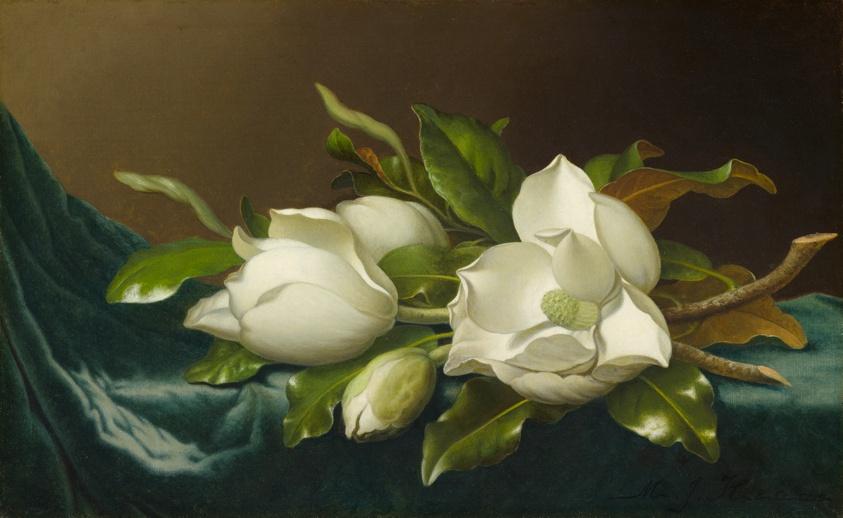
Magnolias on Light Blue Velvet Cloth
Martin Johnson Heade
494 likes124 comments
Paintale uses cookies for essential site functionality and, where enabled, to serve relevant advertising via Google AdSense. You can accept all cookies or reject non-essential ones. See our Privacy Policy for details.
Now viewing
York Harbor, Coast of Maine
Martin Johnson Heade
Period
1871-1900
Theme
Portrait
Medium
Oil on canvas
Current Location
Art Institute of Chicago, Chicago
The Story
This painting represents Martin Johnson Heade’s mature style from the 1870s and contains many of the compositional elements that have led modern scholars to celebrate the artist as a proponent of Luminism. A 20th-century term, Luminism has consistently been linked to the 19th-century philosophical doctrine of transcendentalism. Stylistically, it is characterized by a horizontal format; tight, invisible brushwork; and pervasive light emanating from an unseen source.
Together these qualities embody the intellectual spirit of the American writer and philosopher Ralph Waldo Emerson (1803–1882), who found transcendental unity in the contemplation of nature’s stillness.
As Oil on canvas (38.7 × 76.8 cm (15 1/4 × 30 1/4 in.)), the work shows the tool marks and layering choices typical of Martin Johnson Heade's output in this period — decisions about ground, underpainting, and glaze that a photograph can only partly convey.
Look closely and the painting opens up. Objects you might pass over — a folded letter, a half-drawn curtain, the angle of a glance — were placed to be read. Every prop in a portrait like this is a decision — jewelry, fabric, and hand position were negotiated between painter and patron to shape how the sitter would be remembered.
Housed at Art Institute of Chicago in Chicago, the painting has passed through the hands of collectors, dealers, and institutions before reaching public view — a provenance that is itself part of the object's story.
“A silence so complete it becomes its own witness.”
This painting represents Martin Johnson Heade’s mature style from the 1870s and contains many of the compositional elements that have led modern scholars to celebrate the artist as a proponent of Luminism. A 20th-century term, Luminism has consistently been linked to the 19th-century philosophical doctrine of transcendentalism. Stylistically, it is characterized by a horizontal format; tight, invisible brushwork; and pervasive light emanating from an unseen source. Together these qualities embody the intellectual spirit of the American writer and philosopher Ralph Waldo Emerson (1803–1882), who found transcendental unity in the contemplation of nature’s stillness.
Purchased with funds provided by Mrs. Herbert A. Vance; Americana, Lacy Armour and Roger McCormick endowments; through prior gifts of Dr. and Mrs. R. Gordon Brown, Emily Crane Chadbourne, George F. Harding Collection, Brooks McCormick, and James S. Pennington
Inscriptions: Signed, lower left: M.J. Heade.
William Evans II, Barneveld, New York, and by descent, to 1993; Hollis Taggert, New York, to 1994; Michael Altman, New York, 1995; sold to the Art Institute of Chicago, 1999.
Art Institute of Chicago, Chicago. View on the museum’s official page.
See more works at Art Institute of Chicago or browse the full Martin Johnson Heade collection.
A restrained palette and sculptural lighting create a solemn geometry. The wooden crate and letter anchor the narrative with journalistic precision.
Sources
Keep Exploring
More paintings like this
Martin Johnson Heade
Vincent van Gogh
John Singer Sargent
John Singer Sargent
Albert Besnard
John Singer Sargent
Albert Pinkham Ryder American
Thomas Eakins