Mrs. George Swinton (Elizabeth Ebsworth)
John Singer Sargent
852 likes22 comments
Paintale uses cookies for essential site functionality and, where enabled, to serve relevant advertising via Google AdSense. You can accept all cookies or reject non-essential ones. See our Privacy Policy for details.
Now viewing
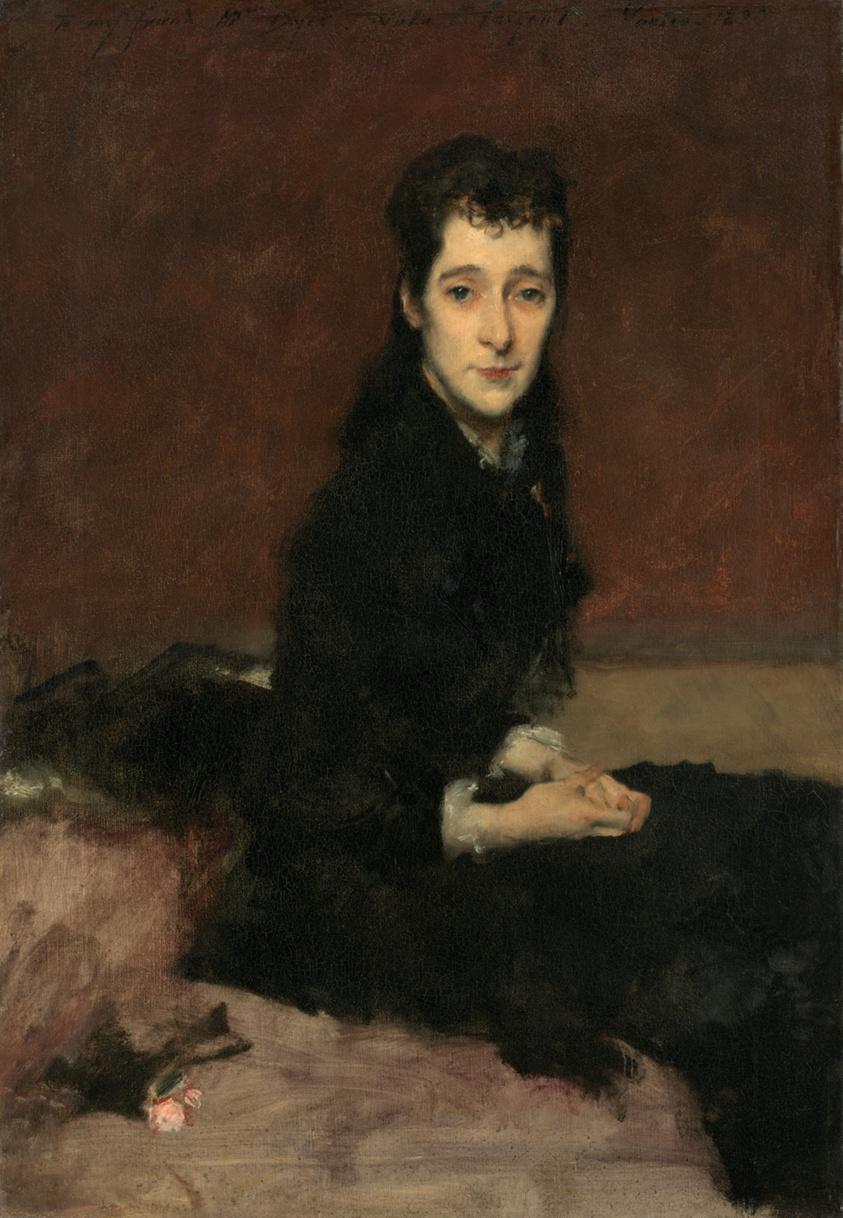
Madame Paul Escudier (Louise Lefevre)
John Singer Sargent
Period
1871-1900
Theme
Portrait
Medium
Oil on canvas
Current Location
Art Institute of Chicago, Chicago
The Story
In this depiction of Frenchwoman Louise Escudier, John Singer Sargent undercut traditional portrait conventions by prioritizing the dramatic effects of light and dark in a Parisian apartment. The picture grew out of a series of atmospheric views of working-class women in darkened interiors that the artist produced on two trips to Venice between 1880 and 1882.
Undertaken in Paris shortly thereafter, this painting transforms those techniques in the portrayal of a fashionable sitter, similarly combining the gestural brushwork of the Impressionists with a heightened chiaroscuro (light and shade) drawn from Spanish Baroque artists such as Diego Velázquez. Such works helped to establish Sargent’s reputation in Paris as a daring and original painter.
Working in Oil on canvas at 129.5 × 91.4 cm (51 × 36 in.), John Singer Sargent constructs depth through value contrast rather than outline, letting figures emerge from darkness the way they would under candlelight or through a shuttered window.
Look closely and the painting opens up. Objects you might pass over — a folded letter, a half-drawn curtain, the angle of a glance — were placed to be read. Every prop in a portrait like this is a decision — jewelry, fabric, and hand position were negotiated between painter and patron to shape how the sitter would be remembered.
Art Institute of Chicago in Chicago now holds the work, where conservators and historians continue to revisit its condition and attribution. Each generation of scholarship adds a layer to how John Singer Sargent's output from this period is understood.
“A silence so complete it becomes its own witness.”
In this depiction of Frenchwoman Louise Escudier, John Singer Sargent undercut traditional portrait conventions by prioritizing the dramatic effects of light and dark in a Parisian apartment. The picture grew out of a series of atmospheric views of working-class women in darkened interiors that the artist produced on two trips to Venice between 1880 and 1882. Undertaken in Paris shortly thereafter, this painting transforms those techniques in the portrayal of a fashionable sitter, similarly combining the gestural brushwork of the Impressionists with a heightened chiaroscuro (light and shade) drawn from Spanish Baroque artists such as Diego Velázquez. Such works helped to establish Sargent’s reputation in Paris as a daring and original painter.
Bequest of Brooks McCormick
Inscriptions: Signed recto, bottom-right, on ground, in red paint: "John S. Sargent 1882"..
The sitter, Louise Lefevre (1861–1950), Paris, 1882; sold through Carnegie Institute, Pittsburgh, to Charles Deering (1852–1927), Chicago and Miami, Nov. 1923 [“Carnegie Sells Two Sargents for $60,000,” <em>Art News</em>, Nov. 10, 1923, 1]; by descent to his daughter, Marion Deering McCormick (1886–1965), Chicago, 1927; by descent to her son, Brooks McCormick (1917–2006), Chicago, 1965; bequeathed to the Art Institute of Chicago, 2007.
Art Institute of Chicago, Chicago. View on the museum’s official page.
See more works at Art Institute of Chicago or browse the full John Singer Sargent collection.
A restrained palette and sculptural lighting create a solemn geometry. The wooden crate and letter anchor the narrative with journalistic precision.
Sources
Keep Exploring
More paintings like this
John Singer Sargent
John Singer Sargent
John Singer Sargent
John Singer Sargent
John Singer Sargent
John Singer Sargent

John Singer Sargent

John Singer Sargent