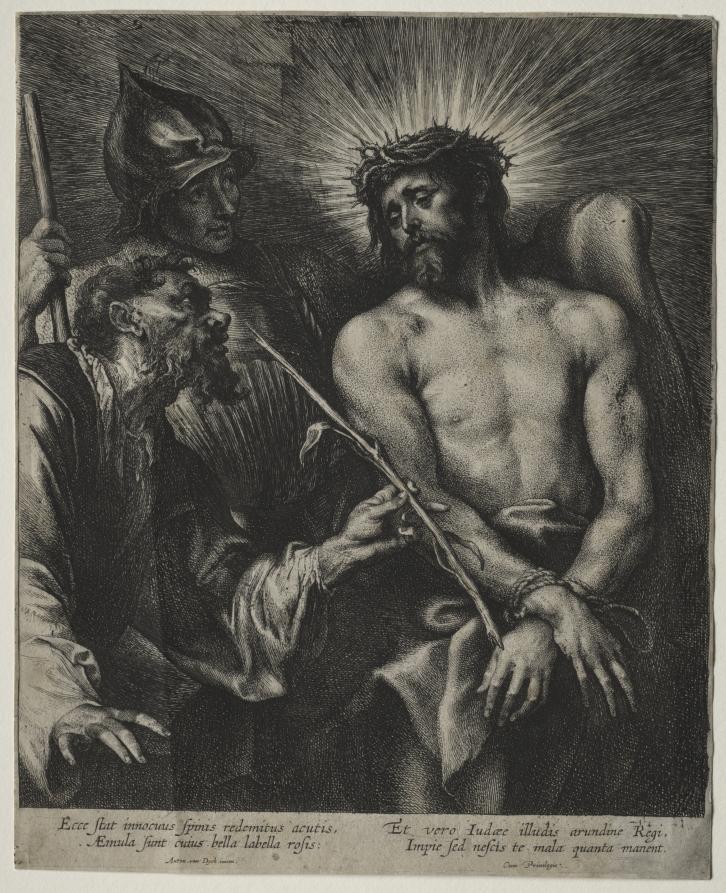
Mocking of Christ
Anthony van Dyck
402 likes32 comments
Paintale uses cookies for essential site functionality and, where enabled, to serve relevant advertising via Google AdSense. You can accept all cookies or reject non-essential ones. See our Privacy Policy for details.
Now viewing
Still Life with Ostrich Egg Cup and the Whitfield Heirlooms
Pieter Gerritsz. van Roestraeten
Period
1650-1700
Theme
Power & Politics
Medium
Oil on canvas
Current Location
Art Institute of Chicago, Chicago
The Story
Trained in the Dutch Republic before making his career in London, Pieter van Roestraeten specialized in compositions populated with luxury goods crafted from rare, imported materials like those seen here. On the right stands a lidded agate cup with detailed silver mounts, counterbalanced to the left of the grouping by another cup, which has been overturned to reveal its mother-of-pearl lining. A piece of valuable and versatile coral, sourced from the coasts of Italy and France, dangles over the front edge of the table.
The central item in this still life, the ostrich egg cup, is in the collection of the Art Institute. Known as the Whitfield Cup, it was created in 1590 by the royal jeweler John Spilman.
The physical object — Oil on canvas, 65.4 × 75.6 cm (25 3/4 × 29 3/4 in.); Framed: 77.2 × 88.3 × 4.5 cm (30 3/8 × 34 3/4 × 1 3/4 in.) — carries its own history of handling and restoration. Pieter Gerritsz. van Roestraeten's brushwork here moves between exacting description and looser, more suggestive passages, a balance typical of Baroque studio practice.
Look closely and the painting opens up. Objects you might pass over — a folded letter, a half-drawn curtain, the angle of a glance — were placed to be read. Crowns, columns, and heraldry quietly insist on legitimacy — this is a painting working hard on behalf of a patron.
Today the painting is held by Art Institute of Chicago in Chicago, where it remains a touchstone for understanding Pieter Gerritsz. van Roestraeten's contribution to Western art. It has been studied, copied, restored, and argued over for centuries — proof that great paintings keep generating new readings long after their creators have gone.
“A silence so complete it becomes its own witness.”
This painting features documented symbols with their own dedicated meaning in art history:
Trained in the Dutch Republic before making his career in London, Pieter van Roestraeten specialized in compositions populated with luxury goods crafted from rare, imported materials like those seen here. On the right stands a lidded agate cup with detailed silver mounts, counterbalanced to the left of the grouping by another cup, which has been overturned to reveal its mother-of-pearl lining. A piece of valuable and versatile coral, sourced from the coasts of Italy and France, dangles over the front edge of the table. The central item in this still life, the ostrich egg cup, is in the collection of the Art Institute. Known as the Whitfield Cup, it was created in 1590 by the royal jeweler John Spilman.
European Decorative Arts Fund
Technique: oil painting, painting techniques, painting (image making), painting.
Possibly John Whitfield, Canterbury (died 1691), based on the inclusion in the painting of the ostrich egg cup mentioned in Whitfield’s will. Possibly by descent in the Whitfield family. Sold, Sotheby’s, London, 15 December, 1976, no. 130. Paris, Loudmer, Hôtel Drouot, June 30, 1993, no. 21. Sold. Phillips, London [according to the catalogue of the 2008 Christie’s sale cited below]; Philip Harris, Baron Harris of Peckham, London; his sale, Christie’s, London, 25 November, 2008, no. 55, in a single lot with the Whitfield cup (2009.113), a silver-gilt mounted ostrich egg cup and cover, which is depicted in the painting; bought by Wynyard Wilkinson as agent for the Art Institute.
Art Institute of Chicago, Chicago. View on the museum’s official page.
See more works at Art Institute of Chicago or browse the full Pieter Gerritsz. van Roestraeten collection.
A restrained palette and sculptural lighting create a solemn geometry. The wooden crate and letter anchor the narrative with journalistic precision.
Sources
Keep Exploring
More paintings like this
Anthony van Dyck

Leonardo da Vinci

Leonardo da Vinci
James McNeill Whistler
Moretto da Brescia

Correggio
Lucas Cranach the Elder
Lucas Cranach the Elder