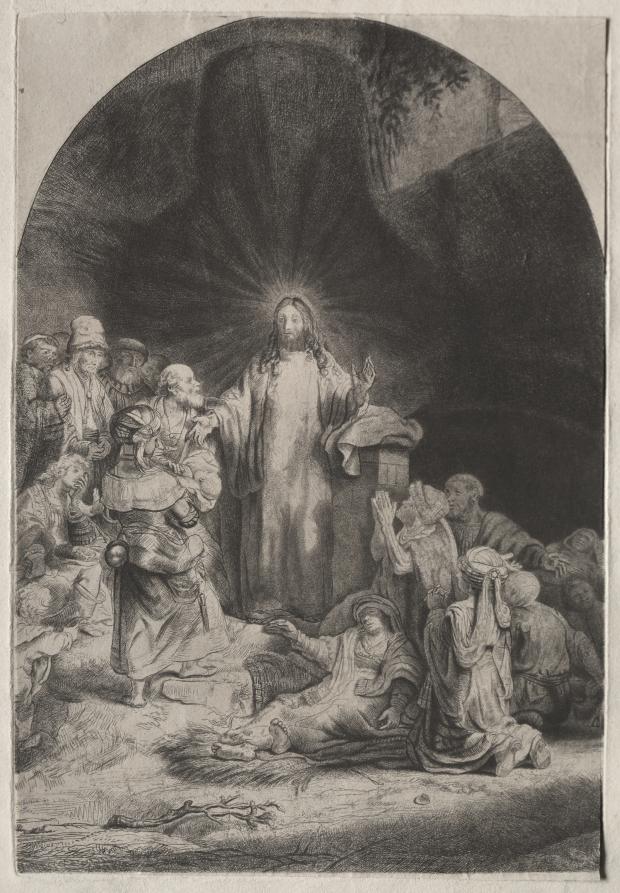
The Hundred Guilder Print
Rembrandt van Rijn
1149 likes139 comments
Paintale uses cookies for essential site functionality and, where enabled, to serve relevant advertising via Google AdSense. You can accept all cookies or reject non-essential ones. See our Privacy Policy for details.
Now viewing
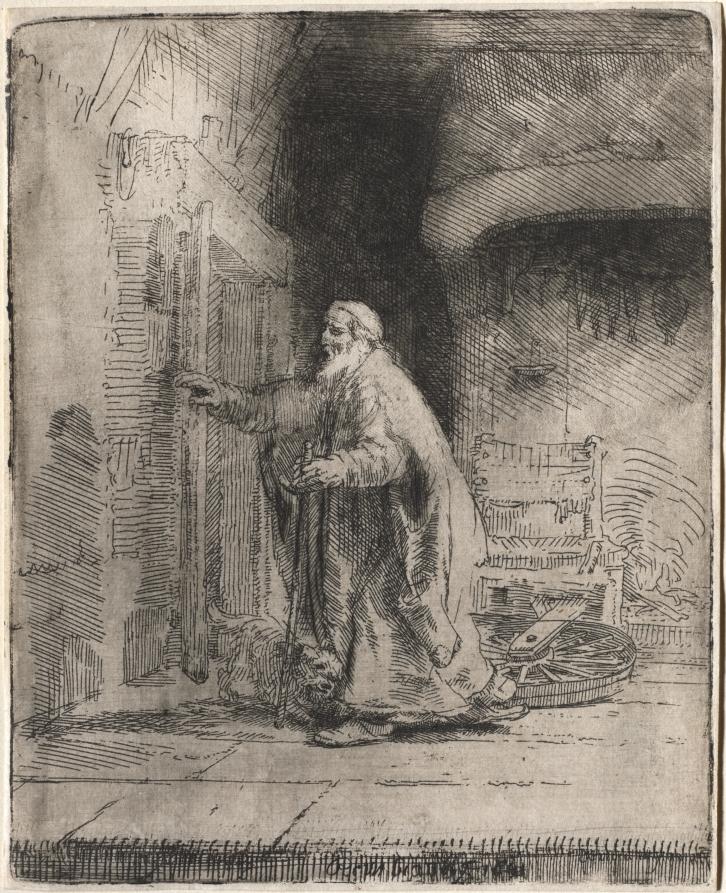
Tobias Healing His Father's Blindness
Rembrandt van Rijn
Period
Baroque
Theme
Daily Life
Medium
Pen and brown ink, touched with white gouache; framing lines in pen and brown ink
Current Location
Cleveland Museum of Art, Cleveland
The Story
Tobias Healing His Father's Blindness, c. 1640–45. Rembrandt van Rijn (Dutch, 1606–1669). Pen and brown ink, touched with white gouache; framing lines in pen and brown ink; sheet: 21.1 x 17.7 cm (8 5/16 x 6 15/16 in.). The Cleveland Museum of Art, Purchase from the J. H. Wade Fund, 1969.69
Created in 1640 during the Baroque period, this work belongs firmly within the daily life tradition. Rembrandt van Rijn worked at a moment when the rivalry between Catholic Baroque drama and Protestant restraint reshaped what a painting could mean. Every gesture, fabric, and gleam of light was decoded by contemporary viewers like a private language.
Working in Pen and brown ink, touched with white gouache; framing lines in pen and brown ink at Sheet: 21.1 x 17.7 cm (8 5/16 x 6 15/16 in.), Rembrandt van Rijn constructs depth through value contrast rather than outline, letting figures emerge from darkness the way they would under candlelight or through a shuttered window.
Look closely and the painting opens up. Objects you might pass over — a folded letter, a half-drawn curtain, the angle of a glance — were placed to be read. The apparent casualness is staged — objects and gestures are arranged to read as a moment caught rather than composed.
Cleveland Museum of Art in Cleveland now holds the work, where conservators and historians continue to revisit its condition and attribution. Each generation of scholarship adds a layer to how Rembrandt van Rijn's output from this period is understood.
“A silence so complete it becomes its own witness.”
Tobias Healing His Father's Blindness, c. 1640–45. Rembrandt van Rijn (Dutch, 1606–1669). Pen and brown ink, touched with white gouache; framing lines in pen and brown ink; sheet: 21.1 x 17.7 cm (8 5/16 x 6 15/16 in.). The Cleveland Museum of Art, Purchase from the J. H. Wade Fund, 1969.69
Accession: 1969.69. Purchase from the J. H. Wade Fund
Technique: Pen and brown ink, touched with white gouache; framing lines in pen and brown ink.
Inscriptions: verso, upper center, in graphite: -13 [crossed out]; upper right, in black chalk: rembrant; upper right, in brown ink: D; upper center, in brown ink: [15-50?] / Tobias; upper left, in brown ink: 9 [sideways]; lower left, in brown ink: [illegible, cropped]; lower left, in brown ink: No 2910; lower left, in brown ink: Rembrandt; lower right, in brown ink: -d[l?]-13 [upside down] .
Ignace-Joseph de Claussin, Paris and London, 1766-1844 (Lugt 485, not stamped); his sale, Batignolles, Paris, 2 December 1844, lot 53 ("Tobie recouvrant la vue") to Van Os. George Jacob Johan van Os, Paris and Amsterdam, 1782-1861; his sale, Roussel et Defer, Paris, 20-22 January, 1851, lot 179 ("Tobie recouvrant la vue") Collection Defer-Dumesnil, Pierre Defer (1798-1870) and Henri Dumesnil (1823-1898), Paris (Lugt 739); his sale, Drouot, Paris, 10-12 May, 1900, lot 84) to Reinach Joseph Reinach, Paris, 1856-1921. by descent to Madame Pierre Goujon, daughter of Joseph Reinach, Paris with Wildenstein & Co., Inc., New York Cleveland Museum of Art, Cleveland, OH
Cleveland Museum of Art, Cleveland. View on the museum’s official page.
See more works at Cleveland Museum of Art or browse the full Rembrandt van Rijn collection.
A restrained palette and sculptural lighting create a solemn geometry. The wooden crate and letter anchor the narrative with journalistic precision.
Sources
Keep Exploring
More paintings like this
Rembrandt van Rijn
Rembrandt van Rijn
Rembrandt van Rijn
Rembrandt van Rijn
Rembrandt van Rijn
Rembrandt van Rijn
Rembrandt van Rijn
Rembrandt van Rijn