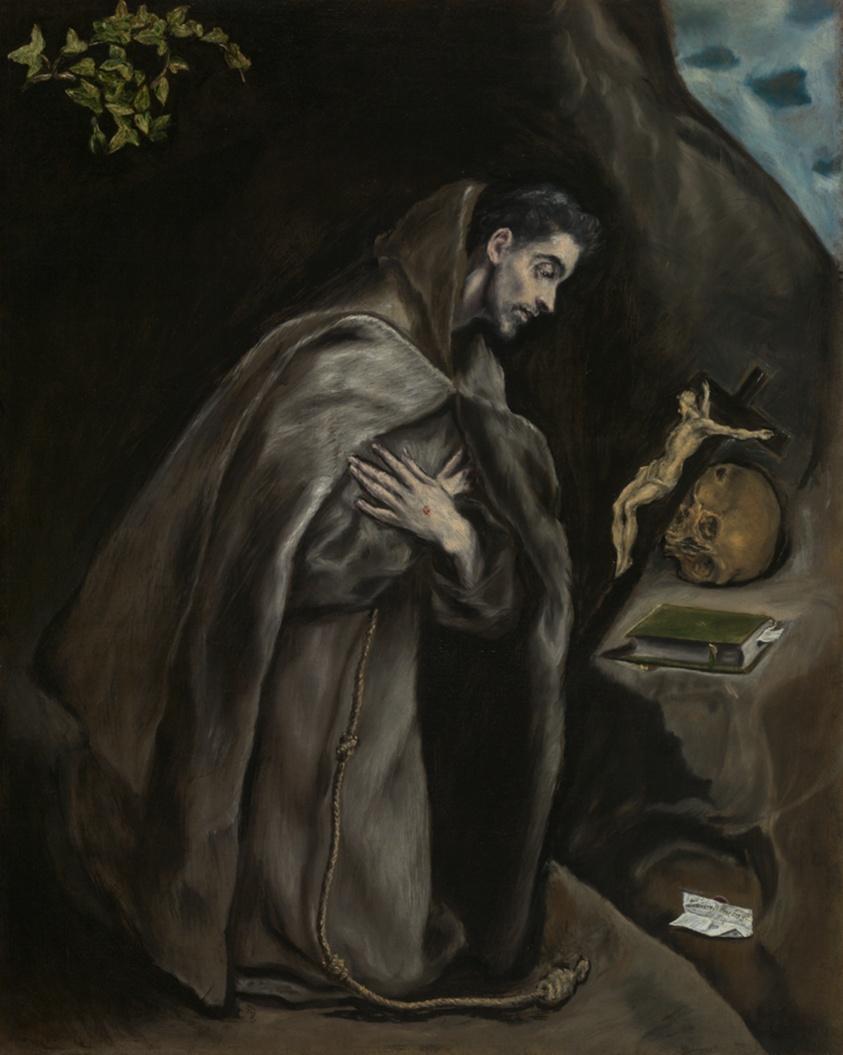
Saint Francis Kneeling in Meditation
El Greco
1251 likes41 comments
Paintale uses cookies for essential site functionality and, where enabled, to serve relevant advertising via Google AdSense. You can accept all cookies or reject non-essential ones. See our Privacy Policy for details.
Now viewing
The Assumption of the Virgin
El Greco
Period
1550-1600
Theme
Tragedy & Death
Medium
Oil on canvas
Current Location
Art Institute of Chicago, Chicago
The Story
The Assumption of the Virgin is an oil on canvas painting by Greek artist Doménikos Theotokópoulos, known as El Greco, in 1577–1579. The painting was a central element of the altarpiece of the church of Santo Domingo el Antiguo in Toledo, Spain. It was the first of nine paintings that El Greco was commissioned to paint for this church. The Assumption of the Virgin was El Greco's first work in Toledo and started his 37-year career there.
Under the influence of Michelangelo, El Greco created a painting that in essence was Italian, with a naturalistic style, monumental figures, and a Roman school palette. The composition of El Greco's depiction of the Assumption of the Virgin resembles Titian's Assumption in the Basilica dei Frari in Venice with Virgin Mary and angels above and the apostles below. On the painting Virgin Mary floats upward which symbolizes her purity, while apostles gathered around her empty tomb express amazement and concern.
Working in Oil on canvas at 403.2 × 211.8 cm (158 3/4 × 83 7/16 in.); Framed: 461.6 × 256.5 × 14 cm (181 3/4 × 101 × 5 9/16 in.), El Greco constructs depth through value contrast rather than outline, letting figures emerge from darkness the way they would under candlelight or through a shuttered window.
Look closely and the painting opens up. Objects you might pass over — a folded letter, a half-drawn curtain, the angle of a glance — were placed to be read. Grief here is choreographed: hands, drapery, and gaze are arranged to guide sympathy rather than simply record a scene.
Art Institute of Chicago in Chicago now holds the work, where conservators and historians continue to revisit its condition and attribution. Each generation of scholarship adds a layer to how El Greco's output from this period is understood.
“A silence so complete it becomes its own witness.”
Assumption of Mary.
The Assumption of the Virgin was the central image of El Greco’s first major commission, an altarpiece for the Church of Santo Domingo el Antiguo, a convent in Toledo, Spain. The painting’s subject, the raising of the Virgin Mary’s body into heaven, relates to the function of the church as the funerary monument of a wealthy noblewoman, Doña Maria de Silva; the iconography of the entire commission focuses on death and salvation. El Greco used broad, free brushwork, flickering hues, rich color harmonies, and bold figural arrangements to arouse devotional fervor in the viewer and impart a deep sense of faith. The composition is divided into two zones: the earthly sphere of the apostles and the celestial realm of the angels. El Greco masterfully compressed many figures into a tall and narrow format: In the earthly zone, the apostles’ faces and gestures express a range of emotions through their dynamic, agitated gestures and poses. They are so individually considered that it seems El Greco studied actual studio models. In contrast, the angels in the heavenly scene above are calm, graceful, and direct in their focus toward the looming figure of the Virgin Mary as she rises into their realm.
Gift of Nancy Atwood Sprague in memory of Albert Arnold Sprague
Materials: oil paint, canvas.
Technique: oil painting, painting techniques, painting, painting (image making).
Inscriptions: Inscribed lower right, in Greek: [Domenikos Theotokopoulos, Cretan, displayed this in 1577] (on paper).
Commissioned 1577 by Don Diego de Castilla for the convent church of Santo Domingo el Antiguo, Toledo; installed with other paintings in the main retable by September 1579; sold c. 1830 to the Infante Don Sebastián Gabriel de Borbón y Braganza (died 1875), Madrid and later Pau, France, but confiscated from him by the Spanish government and installed in the Museo Nacional de la Trinidad, Madrid, in 1835 [Lavice 1864 recorded that the Assumption was on display in the Museo Nacional de Pinturas, but this cannot be confirmed]; returned to Don Sebastián in 1861; his estate in custody of the Spanish government, 1875–87 [see María Teresa Baratech Zelama, “La testamentario del Infante Don Sebastián Gabriel de Borbón y Braganza,” Archivo español de arte 62 (1989), pp. 372–77 for the status of his estate]; his widow, the Infanta María Cristina de Borbón (died 1902), Aranjuez and Madrid; offered for sale, Madrid, October 1902, no. 2, but bought in, then lent by the Infanta’s heirs to the Museo del Prado, Madrid, 1902–04 [see Cossío 1908, p. 594, no. 279]; purchased from them by Galerie Durand-Ruel, Paris, for 100,000 frs. ($17,000), October 1904, with funds provided by Henry O. Havemeyer, New York [see Havemeyer 1961, p. 155]; sold to the Art Institute, July 17, 1906.
Art Institute of Chicago, Chicago. View on the museum’s official page.
See more works at Art Institute of Chicago or browse the full El Greco collection.
A restrained palette and sculptural lighting create a solemn geometry. The wooden crate and letter anchor the narrative with journalistic precision.
Sources
Keep Exploring
More paintings like this
El Greco
El Greco
El Greco
El Greco
El Greco
El Greco
Jacques Louis David
Caravaggio