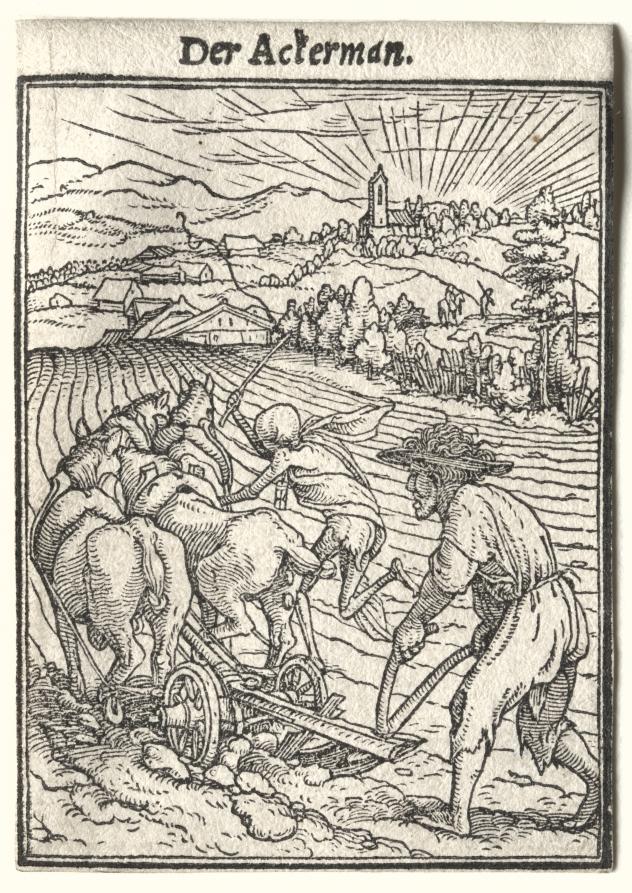
Dance of Death: The Ploughman
Hans Holbein the Younger
1006 likes56 comments
Paintale uses cookies for essential site functionality and, where enabled, to serve relevant advertising via Google AdSense. You can accept all cookies or reject non-essential ones. See our Privacy Policy for details.
Now viewing
Terminus, the Device of Erasmus
Hans Holbein the Younger
Period
Renaissance
Theme
Portrait
Medium
oil on wood
Current Location
Cleveland Museum of Art, Cleveland
The Story
Terminus, the Device of Erasmus, c. 1532. Hans Holbein the Younger (German, active England and Switzerland, 1497/98–1543). Oil on wood; framed: 32.4 x 32.4 x 4.5 cm (12 3/4 x 12 3/4 x 1 3/4 in.); unframed: 21.6 x 21.6 cm (8 1/2 x 8 1/2 in.). The Cleveland Museum of Art, Gift of Dr. and Mrs. Sherman E. Lee in memory of Milton S. Fox, 1971.166
Created in 1532 during the Renaissance period, this work belongs firmly within the portrait tradition. Hans Holbein the Younger worked at a moment when the rivalry between Catholic Baroque drama and Protestant restraint reshaped what a painting could mean. Every gesture, fabric, and gleam of light was decoded by contemporary viewers like a private language.
Executed in oil on wood, measuring Framed: 32.4 x 32.4 x 4.5 cm (12 3/4 x 12 3/4 x 1 3/4 in.); Unframed: 21.6 x 21.6 cm (8 1/2 x 8 1/2 in.), the surface rewards close looking. Hans Holbein the Younger builds the composition through layered glazes and a tightly controlled palette, letting cool shadows recede so that the warm, lit passages step forward.
Look closely and the painting opens up. Objects you might pass over — a folded letter, a half-drawn curtain, the angle of a glance — were placed to be read. Every prop in a portrait like this is a decision — jewelry, fabric, and hand position were negotiated between painter and patron to shape how the sitter would be remembered.
Today the painting is held by Cleveland Museum of Art in Cleveland, where it remains a touchstone for understanding Hans Holbein the Younger's contribution to Western art. It has been studied, copied, restored, and argued over for centuries — proof that great paintings keep generating new readings long after their creators have gone.
“A silence so complete it becomes its own witness.”
Terminus, the Device of Erasmus, c. 1532. Hans Holbein the Younger (German, active England and Switzerland, 1497/98–1543). Oil on wood; framed: 32.4 x 32.4 x 4.5 cm (12 3/4 x 12 3/4 x 1 3/4 in.); unframed: 21.6 x 21.6 cm (8 1/2 x 8 1/2 in.). The Cleveland Museum of Art, Gift of Dr. and Mrs. Sherman E. Lee in memory of Milton S. Fox, 1971.166
Accession: 1971.166. Gift of Dr. and Mrs. Sherman E. Lee in memory of Milton S. Fox
Technique: oil on wood.
Inscriptions: Inscribed in the middle: "CONCEDO NVLLI. [lower right: TERMI / NVS".
Charlotte Frank (London, England) Dr. and Mrs. Sherman Lee, by gift to the Cleveland Museum of Art, 1971. The Cleveland Museum of Art, Cleveland, OH
Cleveland Museum of Art, Cleveland. View on the museum’s official page.
See more works at Cleveland Museum of Art or browse the full Hans Holbein the Younger collection.
A restrained palette and sculptural lighting create a solemn geometry. The wooden crate and letter anchor the narrative with journalistic precision.
Sources
Keep Exploring
More paintings like this
Hans Holbein the Younger
Hans Holbein the Younger
Hans Holbein the Younger
Hans Holbein the Younger
Hans Holbein the Younger
Hans Holbein the Younger
Hans Holbein the Younger
Hans Holbein the Younger