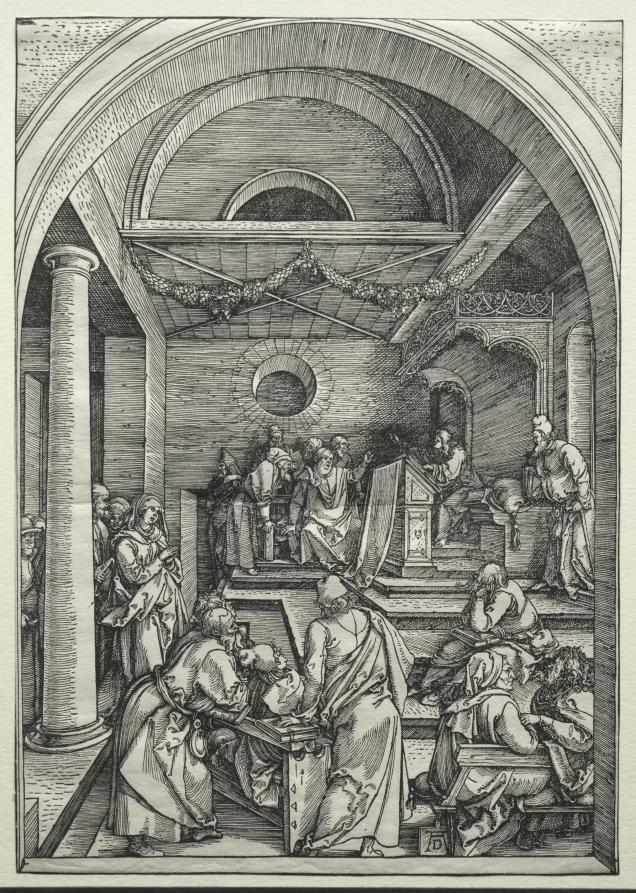
Christ Disputing with Doctors
Albrecht Dürer
579 likes149 comments
Paintale uses cookies for essential site functionality and, where enabled, to serve relevant advertising via Google AdSense. You can accept all cookies or reject non-essential ones. See our Privacy Policy for details.
Now viewing
Arm of Eve
Albrecht Dürer
Period
Renaissance
Theme
Portrait
Medium
point of brush and gray and black wash, brush and gray and black wash, heightened with white gouache
Current Location
Cleveland Museum of Art, Cleveland
The Story
Arm of Eve, 1507. Albrecht Dürer (German, 1471–1528). Point of brush and gray and black wash, brush and gray and black wash, heightened with white gouache; sheet: 34.4 x 26.7 cm (13 9/16 x 10 1/2 in.). The Cleveland Museum of Art, Gift of Alan Kennedy, 1965.470
Created in 1507 during the Renaissance period, this work belongs firmly within the portrait tradition. Albrecht Dürer worked at a moment when the rivalry between Catholic Baroque drama and Protestant restraint reshaped what a painting could mean. Every gesture, fabric, and gleam of light was decoded by contemporary viewers like a private language.
Executed in point of brush and gray and black wash, brush and gray and black wash, heightened with white gouache, measuring Sheet: 34.4 x 26.7 cm (13 9/16 x 10 1/2 in.), the surface rewards close looking. Albrecht Dürer builds the composition through layered glazes and a tightly controlled palette, letting cool shadows recede so that the warm, lit passages step forward.
Look closely and the painting opens up. Objects you might pass over — a folded letter, a half-drawn curtain, the angle of a glance — were placed to be read. Likeness was only part of the job; the painting also had to argue for the sitter's place in the world.
Housed at Cleveland Museum of Art in Cleveland, the painting has passed through the hands of collectors, dealers, and institutions before reaching public view — a provenance that is itself part of the object's story.
“A silence so complete it becomes its own witness.”
Arm of Eve, 1507. Albrecht Dürer (German, 1471–1528). Point of brush and gray and black wash, brush and gray and black wash, heightened with white gouache; sheet: 34.4 x 26.7 cm (13 9/16 x 10 1/2 in.). The Cleveland Museum of Art, Gift of Alan Kennedy, 1965.470
Accession: 1965.470. Gift of Alan Kennedy
Technique: point of brush and gray and black wash, brush and gray and black wash, heightened with white gouache.
Inscriptions: signed, center right, in gray ink: 1507 / [artist monogram: AD]; verso, lower left, in graphite: Nro 24. F 13 z. [bn?] 10zgL. / Watermark: Anchor (similar to Briquet 461) / "franck / 828" in graphite, center verso (Lugt 946).
Joseph Grünling (1875-1845), Vienna (Lugt 1107). Alfred Ritter von Franck (1808-1884), Vienna/Graz (Lugt 947) With Amsler & Ruthardt, Berlin Ferdinand Meder, New York; his sale "with Mr. C. Klackner", New York, 1888 Edward Habich (1818-1901), Kassel; his sale, Gutekunst-Auction, Stuttgart, 27 April 1899, lot 236; Graphische Sammlung Albertina, Vienna (property of Archduke Friedrich of Austria) (Lugt 174) Eugene Meyer (1875-1959), Washington, DC with Arthur H. Harlow & Co., New York with Walter Schatzki, New York; Frits Lugt (1884-1970), Paris/The Hague with Richard H. Zinser, New York. Cleveland Museum of Art, Cleveland, OH
Cleveland Museum of Art, Cleveland. View on the museum’s official page.
See more works at Cleveland Museum of Art or browse the full Albrecht Dürer collection.
A restrained palette and sculptural lighting create a solemn geometry. The wooden crate and letter anchor the narrative with journalistic precision.
Sources
Keep Exploring
More paintings like this
Albrecht Dürer
Albrecht Dürer
Albrecht Dürer
Albrecht Dürer
Albrecht Dürer
Albrecht Dürer
Albrecht Dürer
Albrecht Dürer