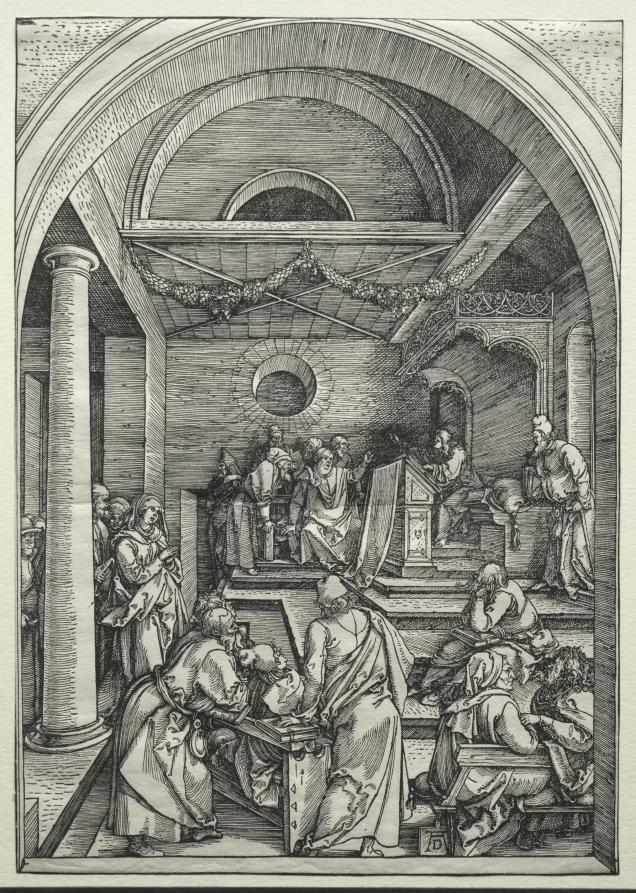
Christ Disputing with Doctors
Albrecht Dürer
579 likes149 comments
Paintale uses cookies for essential site functionality and, where enabled, to serve relevant advertising via Google AdSense. You can accept all cookies or reject non-essential ones. See our Privacy Policy for details.
Now viewing
Saint Eustace
Albrecht Dürer
Period
Renaissance
Theme
Portrait
Medium
engraving
Current Location
Cleveland Museum of Art, Cleveland
The Story
The Vision of Saint Eustace is a painting by Annibale Carracci, showing Saint Eustace and his vision of a crucifix between the horns of a stag whilst out hunting. The saint is set in one of the first landscapes by any of the Carracci brothers, showing how he was influenced by Venetian landscape painting until about 1598 after a stay in the city in 1587 and 1588. Specific influences include Titian's Penitent Saint Jerome (Louvre) and the naturalism of Jacopo Bassano.
Critics argue the composition is based on two prints by Cornelis Cort, a Flemish printer - Penitent St Jerome and The Vision of Saint Eustace. These prints were in turn based on ideas by the Lombard painter Girolamo Muziano, who was also influenced by Venetian models. The dogs and some other details are drawn from Saint Eustace, an engraving by Albrecht Dürer of the same subject. It is generally dated to 1585-1586 due to its stylistic similarities with other more-securely dated works from those years by the artist.
Executed in engraving, measuring Image: 35.4 x 26 cm (13 15/16 x 10 1/4 in.); Sheet: 35.4 x 26 cm (13 15/16 x 10 1/4 in.), the surface rewards close looking. Albrecht Dürer builds the composition through layered glazes and a tightly controlled palette, letting cool shadows recede so that the warm, lit passages step forward.
Look closely and the painting opens up. Objects you might pass over — a folded letter, a half-drawn curtain, the angle of a glance — were placed to be read. The sitter is constructed: clothes, pose, and attributes were chosen to project status, virtue, and lineage.
Today the painting is held by Cleveland Museum of Art in Cleveland, where it remains a touchstone for understanding Albrecht Dürer's contribution to Western art. It has been studied, copied, restored, and argued over for centuries — proof that great paintings keep generating new readings long after their creators have gone.
“A silence so complete it becomes its own witness.”
Saint Eustace.
This painting features documented symbols with their own dedicated meaning in art history:
Saint Eustace, c. 1501. Albrecht Dürer (German, 1471–1528). Engraving; image: 35.4 x 26 cm (13 15/16 x 10 1/4 in.); sheet: 35.4 x 26 cm (13 15/16 x 10 1/4 in.). The Cleveland Museum of Art, Bequest of Leonard C. Hanna Jr., 1958.109
Accession: 1958.109. Bequest of Leonard C. Hanna Jr.
Materials: oil paint, canvas.
Technique: engraving.
Estate of Leonard C. Hanna, Jr., Cleveland, OH, given to The Cleveland Museum of Art, Cleveland, OH The Cleveland Museum of Art, Cleveland, OH
Cleveland Museum of Art, Cleveland. View on the museum’s official page.
See more works at Cleveland Museum of Art or browse the full Albrecht Dürer collection.
A restrained palette and sculptural lighting create a solemn geometry. The wooden crate and letter anchor the narrative with journalistic precision.
Sources
Keep Exploring
More paintings like this
Albrecht Dürer
Albrecht Dürer
Albrecht Dürer
Albrecht Dürer
Albrecht Dürer
Albrecht Dürer
Albrecht Dürer
Albrecht Dürer