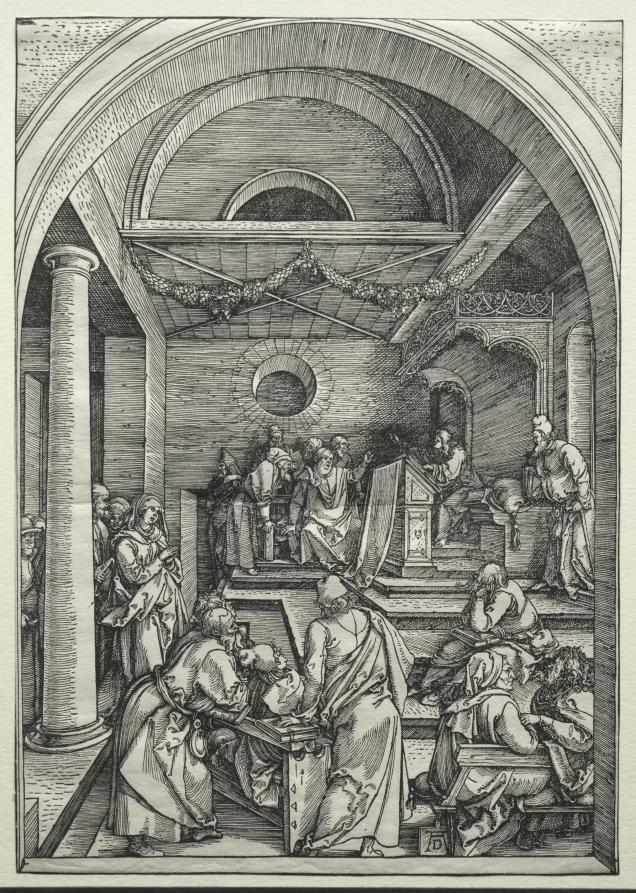
Christ Disputing with Doctors
Albrecht Dürer
579 likes149 comments
Paintale uses cookies for essential site functionality and, where enabled, to serve relevant advertising via Google AdSense. You can accept all cookies or reject non-essential ones. See our Privacy Policy for details.
Now viewing
The Sea Monster
Albrecht Dürer
Period
Renaissance
Theme
Portrait
Medium
engraving
Current Location
Cleveland Museum of Art, Cleveland
The Story
The Sea Monster (German: Das Meerwunder) is a c. 1498–1500 copper engraving by the German Renaissance master Albrecht Dürer. It shows a voluptuous naked woman riding on the back of a merman, a male creature who is half-man, half-fish. The man wears a beard and antlers, while his lower body is covered in scales. The woman has seemingly been snatched and dragged away from the river bank; her companions are shown scrambling out of the water in panic, raising their arms in protest or lying down weeping.
The woman wears an extravagant Milanese headdress and her mouth is open in a cry as she looks back at her friends in the distance. Despite the woman's gaze back at the bank and her open mouth, her relaxed Venus like pose suggests to some critics that she is not overly concerned with her plight. For this reason writer Jonathan Jones described the engraving as a "troubling, wondrous image of the erotic", while historian Walter L. Strauss notes that her abduction may be a device to legitimise her nudity.
Working in engraving at Sheet: 24.5 x 18.6 cm (9 5/8 x 7 5/16 in.); Mat Size: 49 x 36.3 cm (19 5/16 x 14 5/16 in.), Albrecht Dürer constructs depth through value contrast rather than outline, letting figures emerge from darkness the way they would under candlelight or through a shuttered window.
Look closely and the painting opens up. Objects you might pass over — a folded letter, a half-drawn curtain, the angle of a glance — were placed to be read. The sitter is constructed: clothes, pose, and attributes were chosen to project status, virtue, and lineage.
Today the painting is held by Cleveland Museum of Art in Cleveland, where it remains a touchstone for understanding Albrecht Dürer's contribution to Western art. It has been studied, copied, restored, and argued over for centuries — proof that great paintings keep generating new readings long after their creators have gone.
“A silence so complete it becomes its own witness.”
sea monster.
This painting features documented symbols with their own dedicated meaning in art history:
The Sea Monster, c. 1501. Albrecht Dürer (German, 1471–1528). Engraving; sheet: 24.5 x 18.6 cm (9 5/8 x 7 5/16 in.); mat size: 49 x 36.3 cm (19 5/16 x 14 5/16 in.). The Cleveland Museum of Art, Gift of Leonard C. Hanna Jr., 1934.340
Accession: 1934.340. Gift of Leonard C. Hanna Jr.
Materials: copper engraving print, laid paper.
Technique: engraving.
Cleveland Museum of Art, Cleveland. View on the museum’s official page.
See more works at Cleveland Museum of Art or browse the full Albrecht Dürer collection.
A restrained palette and sculptural lighting create a solemn geometry. The wooden crate and letter anchor the narrative with journalistic precision.
Sources
Keep Exploring
More paintings like this
Albrecht Dürer
Albrecht Dürer
Albrecht Dürer
Albrecht Dürer
Albrecht Dürer
Albrecht Dürer
Albrecht Dürer
Albrecht Dürer