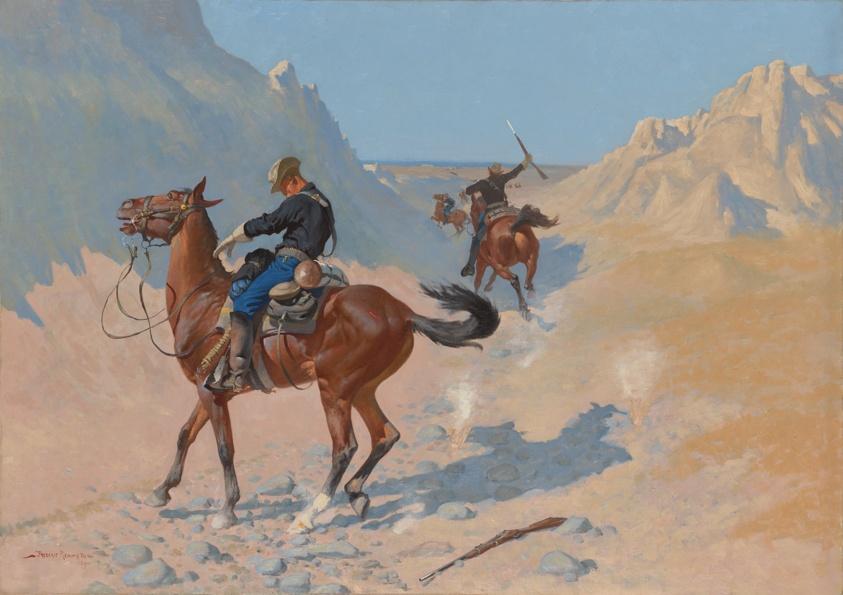
The Advance-Guard, or The Military Sacrifice (The Ambush)
Frederic Remington
1034 likes44 comments
Paintale uses cookies for essential site functionality and, where enabled, to serve relevant advertising via Google AdSense. You can accept all cookies or reject non-essential ones. See our Privacy Policy for details.
Now viewing
A Mexican Vaquero
Frederic Remington
Period
1871-1900
Theme
Portrait
Medium
Oil on canvas
Current Location
Art Institute of Chicago, Chicago
The Story
A trip to Mexico in 1889 provided Frederic Remington with a wealth of firsthand material for paintings and illustrations created later in his New York studio. Here Remington depicted a vaquero, a Mexican horseman similar to the cowboys of the American frontier. The figure sits astride his horse at an elevated position, his head and torso above the horizon, outlined by the pale blue sky behind him. Portraying the man with a direct gaze and his hand on the reins, Remington suggested that the vaquero was a fixture of the local terrain.
The artist created a version of A Mexican Vaquero as a wood engraving, which appeared in Harper’s Monthly in 1891.
As Oil on canvas (82.6 × 58.4 cm (32 1/2 × 23 in.)), the work shows the tool marks and layering choices typical of Frederic Remington's output in this period — decisions about ground, underpainting, and glaze that a photograph can only partly convey.
Look closely and the painting opens up. Objects you might pass over — a folded letter, a half-drawn curtain, the angle of a glance — were placed to be read. The sitter is constructed: clothes, pose, and attributes were chosen to project status, virtue, and lineage.
Housed at Art Institute of Chicago in Chicago, the painting has passed through the hands of collectors, dealers, and institutions before reaching public view — a provenance that is itself part of the object's story.
“A silence so complete it becomes its own witness.”
A trip to Mexico in 1889 provided Frederic Remington with a wealth of firsthand material for paintings and illustrations created later in his New York studio. Here Remington depicted a vaquero, a Mexican horseman similar to the cowboys of the American frontier. The figure sits astride his horse at an elevated position, his head and torso above the horizon, outlined by the pale blue sky behind him. Portraying the man with a direct gaze and his hand on the reins, Remington suggested that the vaquero was a fixture of the local terrain. The artist created a version of A Mexican Vaquero as a wood engraving, which appeared in Harper’s Monthly in 1891.
George F. Harding Collection
Inscriptions: Signed, lower right: "Copyright 1890 / By/ Frederic Remington".
George F. Harding, Jr. (1868–1939), Chicago, by 1939 [Harding Collection no. 400]; bequeathed to the George F. Harding Museum, Chicago, 1939 [the museum closed in 1964 and the collection was placed in storage in Chicago and New York]; transferred to the Art Institute of Chicago, July 30, 1982 [incoming receipt, RX13605, July 30, 1982; copy in curatorial object file]; accessioned by the Art Institute of Chicago, 1982.
Art Institute of Chicago, Chicago. View on the museum’s official page.
See more works at Art Institute of Chicago or browse the full Frederic Remington collection.
A restrained palette and sculptural lighting create a solemn geometry. The wooden crate and letter anchor the narrative with journalistic precision.
Sources
Keep Exploring
More paintings like this
Frederic Remington
Frederic Remington
Frederic Remington
Frederic Remington
Frederic Remington
Frederic Remington
Frederic Remington
Frederic Remington