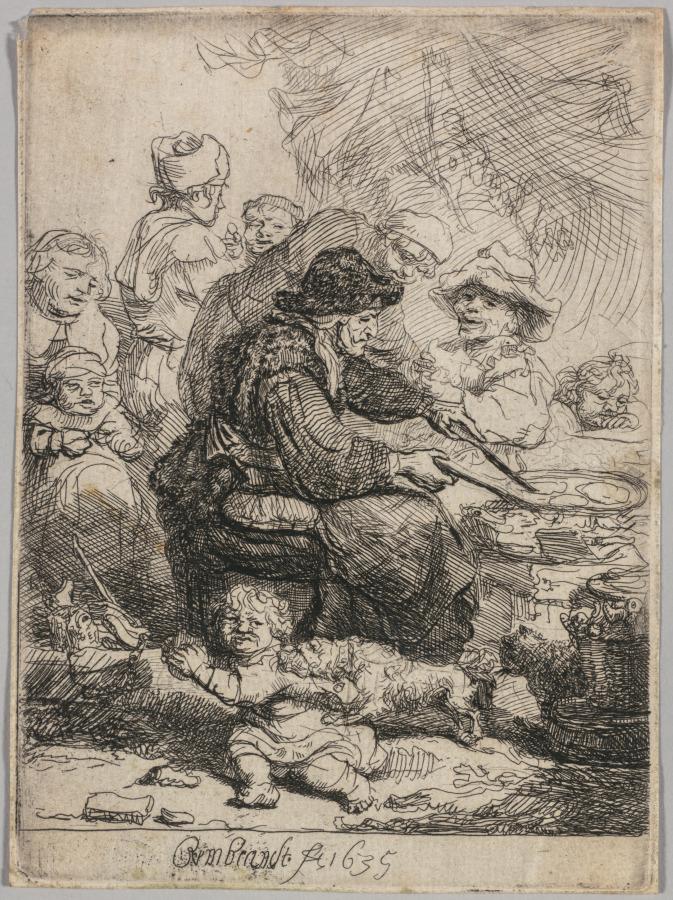
The Pancake Woman
Rembrandt van Rijn
1200 likes130 comments
Paintale uses cookies for essential site functionality and, where enabled, to serve relevant advertising via Google AdSense. You can accept all cookies or reject non-essential ones. See our Privacy Policy for details.
Now viewing
Old Man with a Gold Chain
Rembrandt van Rijn
Period
1600-1650
Theme
Portrait
Medium
Oil on panel
Current Location
Art Institute of Chicago, Chicago
The Story
Old Man with a Gold Chain is a portrait by Rembrandt, painted in oils on canvas around 1631. It is now in the Art Institute of Chicago. There are copies including a second version which is now considered according to Scholar Gary Schwartz as an Autograph Replica By Rembrandt Van Rijn. This painting was documented by Hofstede de Groot as a portrait of Rembrandt's father in 1915, who wrote:675. HARMEN GERRITSZ VAN RIJN. Half-length, without hands; almost life size. He is inclined to the left, but his head and eyes are turned to the right.
He wears a dark purple cloak, over which hangs a gold chain with a medallion. Round his neck is a small close-fitting steel gorget. In his right ear is a pearl. He has a short greyish beard, and curly hair covered by a broad-brimmed black hat with two dark ostrich feathers. Painted about 1631. Signed on the left at foot with the monogram "R H L"; canvas, 32 inches by 30 inches. Bode 217; Wb. -HdG. 29. Mentioned by Moes, No. 6687, ii; Bode, p. 413; Dutuit, p. 43; Michel, pp. 44, 557, 561 [35, 432, 443]. Sale. Beresford Hope, London, May 1886.
The physical object — Oil on panel, 83.1 × 75.7 cm (32 3/4 × 29 3/4 in.); Framed: 105.1 × 99.5 cm (41 3/8 × 39 3/16 in.) — carries its own history of handling and restoration. Rembrandt van Rijn's brushwork here moves between exacting description and looser, more suggestive passages, a balance typical of Baroque studio practice.
Look closely and the painting opens up. Objects you might pass over — a folded letter, a half-drawn curtain, the angle of a glance — were placed to be read. The sitter is constructed: clothes, pose, and attributes were chosen to project status, virtue, and lineage.
Housed at Art Institute of Chicago in Chicago, the painting has passed through the hands of collectors, dealers, and institutions before reaching public view — a provenance that is itself part of the object's story.
“A silence so complete it becomes its own witness.”
Rembrandt's father, feather, chain, gorget.
This painting features documented symbols with their own dedicated meaning in art history:
This compelling figure—fancifully adorned with a steel gorget (armor protecting the throat and upper chest), golden chain, and plumed beret—represents a new commodity on the Northern European art market: a tronie, or character study. While artists had created such studies since the 1500s, Rembrandt and his colleague Jan Lievens made these images into more affordable alternatives to portraits, heightening their appeal by introducing bold visual elements like dramatic lighting, whimsical costumes, and dynamic poses. Rembrandt and his colleagues painted this model frequently; although he has been called “Rembrandt’s father,” recent research suggests that the “Old Man” may have been the keeper of an almshouse in Leiden, the Netherlands. Although tronies were less expensive than commissioned portraits, Rembrandt invested just as much skill in them. The attention given to the folds of flesh beneath the eyes, the prickly, tightly trimmed beard, and the highlights in the gorget and gold chain reveal a talented painter engaged in the joys of painting. The prominent gold chain appears in several works from Rembrandt’s Leiden and Amsterdam periods: He must have had one in his studio. But unlike his acclaimed peers Peter Paul Rubens and Anthony van Dyck, Rembrandt never received one as a gift from a royal patron.
Mr. and Mrs. W. W. Kimball Collection
Materials: oil paint, panel.
Technique: oil painting, painting, painting techniques, panel painting, painting (image making).
Inscriptions: Monogramed lower left: RHL.
Jacob Alewijn, Amsterdam; by descent to his widow Margaretha Helena Graafland (died 1766); sold Amsterdam, June 10, 1767, no. 14, to Ketelaar, “Rembrandt. Het Hoofd van een Oud Man, zynde een Kniestuk, Levensgroote, met een dokere Mantel om, en een gouden Keten met een Medaille om den hals. Het hoofd is van vooren en op zyde te zien; gekeerd naar den linker Schouder, en gedekt met een Fluweelen Muts, voorzien met een groote Pluim. Zynde zeer helder, krachtig en uitvoorig op Paneel geschilderd. Hoog 35, breed 30 duim”(The head of an old man, knee-length and life size, wearing a dark cloak and a golden chain with a medallion around his neck. The head is seen from the front and to one side, turned toward the left shoulder, and covered with a velvet cap with a large plume. 90 x 77.1 cm) [For the identification of the consignor at this sale, see Rembrandt Research Project 1982, with evidence that the height of the picture was later slightly reduced]. Matthew Piers Watt Boulton, Tew Park, Oxfordshire; his estate sale Christie’s, London, December 9, 1911, no. 14, as the Father of Rembrandt for £220 10s. to Shepherd [annotated sale catalogue at Frick Art Reference Library; for the identity of 1922.4467 and the painting in the Boulton sale, see Bode 1912]. Lippmann, London, with a half share acquired by P. and D. Colnaghi, London, February 12, 1912 [letter from Lavinia Davies, Colnaghi, to Susan Wise, 28 November, 1977 in curatorial file]; Colnaghi sold their share in March, 1912, with Lippmann, Knoedler, and Julius Böhler sharing ownership in the picture [letter of Lavinia Davies cited above]; sold by Böhler to Marczell de Nemes, Budapest, 17 June, 1912; offered for sale Galerie Manzi, Joyant, Paris, 17-18 June, 1913, no. 60, as Portrait du père de Rembrandt, bought in and returned to Julius Böhler in July 1913 [letter from Julius Böhler to Susan Wise, September 20, 1977 in curatorial file]; sold by Julius Böhler to Reinhardt, New York [letter from Böhler cited above; in a letter of June 14, 1977, Julius Böhler noted that Reinhardt was the American representative for their firm]; sold to Mrs. W. W. Kimball, (died 1921), Chicago, by 1914 [Valentiner 1914]; bequeathed, 1922.
Art Institute of Chicago, Chicago. View on the museum’s official page.
See more works at Art Institute of Chicago or browse the full Rembrandt van Rijn collection.
A restrained palette and sculptural lighting create a solemn geometry. The wooden crate and letter anchor the narrative with journalistic precision.
Sources
Keep Exploring
More paintings like this
Rembrandt van Rijn
Rembrandt van Rijn
Rembrandt van Rijn
Rembrandt van Rijn
Rembrandt van Rijn
Rembrandt van Rijn
Rembrandt van Rijn
Rembrandt van Rijn