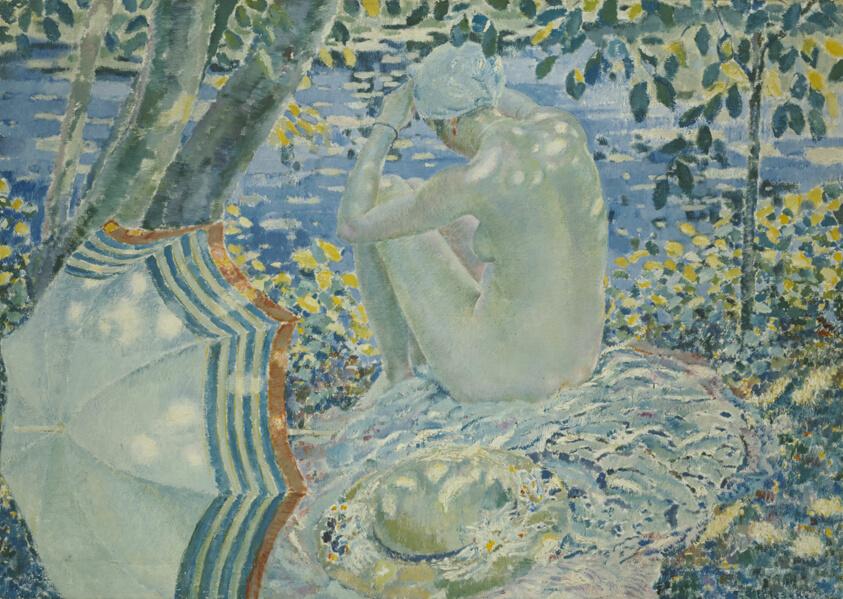
On the Bank
Frederick Carl Frieseke
1068 likes18 comments
Paintale uses cookies for essential site functionality and, where enabled, to serve relevant advertising via Google AdSense. You can accept all cookies or reject non-essential ones. See our Privacy Policy for details.
Now viewing
Lights of Other Days
John Frederick Peto
Period
1901-1920
Theme
Daily Life
Medium
Oil on canvas
Current Location
Art Institute of Chicago, Chicago
The Story
Lights of Other Days, like many of John F. Peto’s still lifes, is replete with nostalgia. Strewn along a shallow shelf above a doorframe is an array of old, well-worn objects: candleholders with wax candles nearly used up, rusty oil lamps, and torn books. These discarded commonplace objects allude to older ways of life and fading memories.
Peto specialized in trompe l’oeil (fools the eye) pictures; yet his soft-edged style is suggestive of the artist’s hand rather than the heightened illusionism employed by other trompe l’oeil painters such as William Harnett. Trained in Philadelphia, Peto stopped exhibiting his work at professional venues by 1890, creating compositions instead for local patrons near his New Jersey home.
As Oil on canvas (77.5 × 115 cm (30 1/2 × 45 1/4 in.)), the work shows the tool marks and layering choices typical of John Frederick Peto's output in this period — decisions about ground, underpainting, and glaze that a photograph can only partly convey.
Look closely and the painting opens up. Objects you might pass over — a folded letter, a half-drawn curtain, the angle of a glance — were placed to be read. Scenes like this were prized precisely because they made ordinary labor and leisure worth painting at all.
Housed at Art Institute of Chicago in Chicago, the painting has passed through the hands of collectors, dealers, and institutions before reaching public view — a provenance that is itself part of the object's story.
“A silence so complete it becomes its own witness.”
Lights of Other Days, like many of John F. Peto’s still lifes, is replete with nostalgia. Strewn along a shallow shelf above a doorframe is an array of old, well-worn objects: candleholders with wax candles nearly used up, rusty oil lamps, and torn books. These discarded commonplace objects allude to older ways of life and fading memories. Peto specialized in trompe l’oeil (fools the eye) pictures; yet his soft-edged style is suggestive of the artist’s hand rather than the heightened illusionism employed by other trompe l’oeil painters such as William Harnett. Trained in Philadelphia, Peto stopped exhibiting his work at professional venues by 1890, creating compositions instead for local patrons near his New Jersey home.
Goodman Fund
Inscriptions: Signed, on verso: "John F. Peto".
Art Institute of Chicago, Chicago. View on the museum’s official page.
See more works at Art Institute of Chicago or browse the full John Frederick Peto collection.
A restrained palette and sculptural lighting create a solemn geometry. The wooden crate and letter anchor the narrative with journalistic precision.
Sources
Keep Exploring
More paintings like this
Frederick Carl Frieseke

John Singer Sargent

Childe Hassam

Childe Hassam

Robert Henri

Leonardo da Vinci

Leonardo da Vinci

Leonardo da Vinci