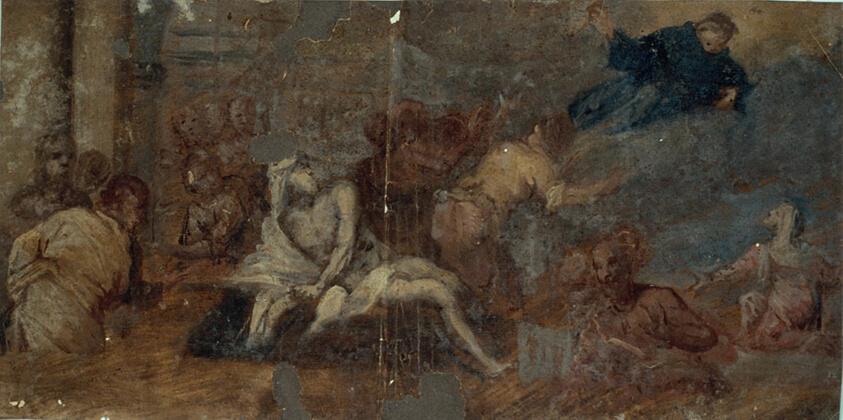
Saint Anthony Appearing to a Sick Man
Follower of Domenico Robusti, called Tintoretto Italian
1183 likes93 comments
Paintale uses cookies for essential site functionality and, where enabled, to serve relevant advertising via Google AdSense. You can accept all cookies or reject non-essential ones. See our Privacy Policy for details.
Now viewing
Saint Jerome in the Wilderness
Workshop of Veronese
Period
1550-1600
Theme
Religion & Mythology
Medium
Oil on canvas
Current Location
Art Institute of Chicago, Chicago
The Story
Paolo Veronese maintained an active workshop that included members of his family to meet the demand for paintings in his style. This picture may have been a collaboration between the artist’s son, Carlo Caliari, and brother Benedetto Caliari, who painted the landscape and figural elements, respectively. The broad brushstrokes do not demonstrate the freedom or effects of flickering light found in Veronese’s own work.
Created in 1585 during the 1550-1600 period, this work belongs firmly within the religion & mythology tradition. Workshop of Veronese worked at a moment when the rediscovery of classical antiquity reshaped what a painting could mean. Every gesture, fabric, and gleam of light was decoded by contemporary viewers like a private language.
As Oil on canvas (134.8 × 176.6 cm (53 1/8 × 69 7/8 in.); Framed: 163.2 × 203.9 × 6.4 cm (64 1/4 × 80 1/4 × 2 1/2 in.)), the work shows the tool marks and layering choices typical of Workshop of Veronese's output in this period — decisions about ground, underpainting, and glaze that a photograph can only partly convey.
Look closely and the painting opens up. Objects you might pass over — a folded letter, a half-drawn curtain, the angle of a glance — were placed to be read. The iconography draws on scripture and classical myth, but the emotional weight is entirely human.
Housed at Art Institute of Chicago in Chicago, the painting has passed through the hands of collectors, dealers, and institutions before reaching public view — a provenance that is itself part of the object's story.
“A silence so complete it becomes its own witness.”
Paolo Veronese maintained an active workshop that included members of his family to meet the demand for paintings in his style. This picture may have been a collaboration between the artist’s son, Carlo Caliari, and brother Benedetto Caliari, who painted the landscape and figural elements, respectively. The broad brushstrokes do not demonstrate the freedom or effects of flickering light found in Veronese’s own work.
Charles H. and Mary F. S. Worcester Collection
Technique: oil painting, painting techniques, painting (image making), painting.
Rev. John Sanford, Florence and London, by 1837 [see Sanford catalogue, 1837, p. 19, no. 102.] Sold Christie's, London, March 9, 1839, no. 131, for £23 2s, to G. Yates. Possibly George Byng (1764-1847) or his nephew George Byng (1806-1886), second earl of Strafford of the third creation, Wrotham Park, Barnet (Middlesex) [according to information supplied by M. Knoedler; but unverified.] A.L. Nicholson, London, by 1930 [see letter of 20 February 1930 from Bernard Berenson to Nicholson in curatorial file]. M. Knoedler, New York, acquired December 1944 (stock no. A 2989) and sold to the Art Institute, May 10, 1945.
Art Institute of Chicago, Chicago. View on the museum’s official page.
See more works at Art Institute of Chicago or browse the full Workshop of Veronese collection.
A restrained palette and sculptural lighting create a solemn geometry. The wooden crate and letter anchor the narrative with journalistic precision.
Sources
Keep Exploring
More paintings like this
Follower of Domenico Robusti, called Tintoretto Italian
El Greco
Andrea Sacchi
Anthony van Dyck

Leonardo da Vinci

Leonardo da Vinci

Leonardo da Vinci

Leonardo da Vinci