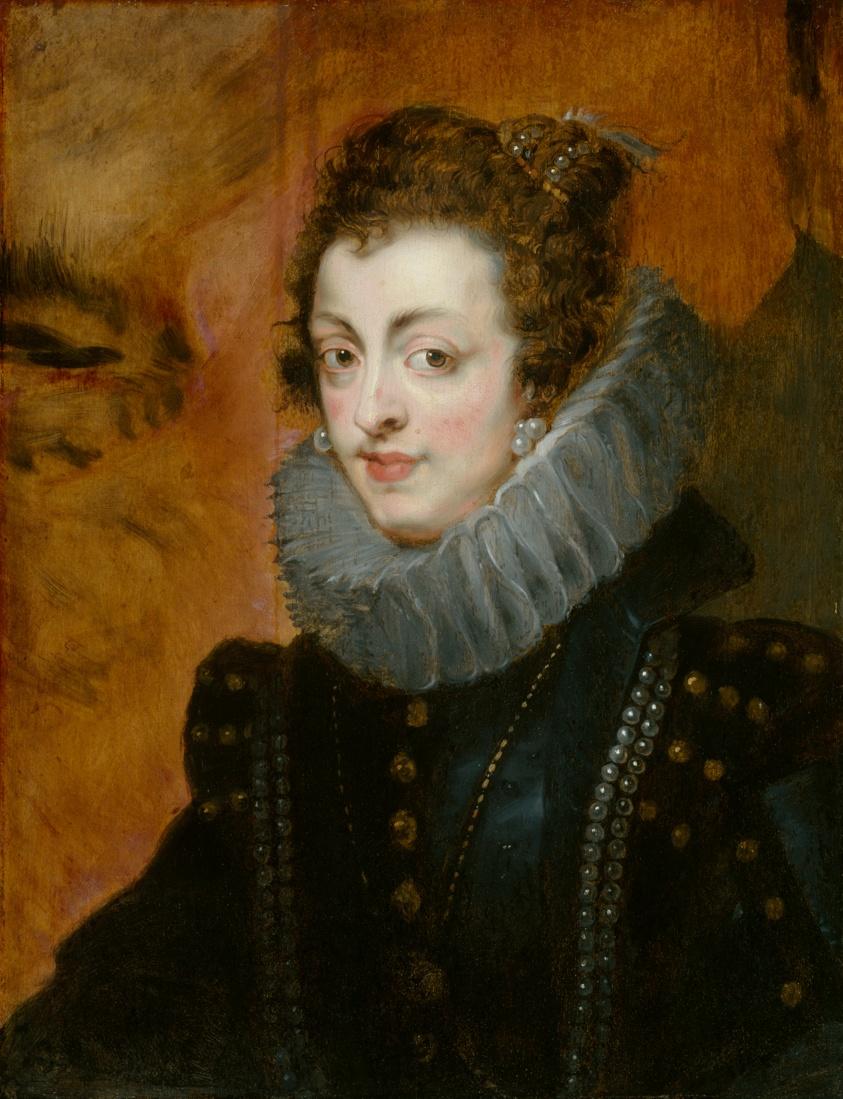
Portrait of Isabella of Bourbon
Follower of Peter Paul Rubens
611 likes41 comments
Paintale uses cookies for essential site functionality and, where enabled, to serve relevant advertising via Google AdSense. You can accept all cookies or reject non-essential ones. See our Privacy Policy for details.
Now viewing
The Rommel-Pot Player
Workshop of Frans Hals
Period
1600-1650
Theme
Portrait
Medium
Oil on panel
Current Location
Art Institute of Chicago, Chicago
The Story
Joy alights on the faces of a crowd of children staring spellbound up at a rommel-pot player. A rommel pot is a musical instrument made out of an earthenware jar with a stick inserted through an animal skin covering. The player rotates and rubs the stick to produce a droning noise akin to a duck call. It was often played during Shrovetide, the festive period before the start of Lent, also known as Carnival. This street performer wears a foxtail hat, a traditional attribute of a fool, highlighting the silliness of the occasion.
Frans Hals’s workshop produced multiple versions of this scene, which was likely popular for the way the artist captured childhood delight.
Working in Oil on panel at 39.1 × 30.5 cm (15 1/16 × 12 5/16 in.), Workshop of Frans Hals constructs depth through value contrast rather than outline, letting figures emerge from darkness the way they would under candlelight or through a shuttered window.
Look closely and the painting opens up. Objects you might pass over — a folded letter, a half-drawn curtain, the angle of a glance — were placed to be read. Every prop in a portrait like this is a decision — jewelry, fabric, and hand position were negotiated between painter and patron to shape how the sitter would be remembered.
Housed at Art Institute of Chicago in Chicago, the painting has passed through the hands of collectors, dealers, and institutions before reaching public view — a provenance that is itself part of the object's story.
“A silence so complete it becomes its own witness.”
Joy alights on the faces of a crowd of children staring spellbound up at a rommel-pot player. A rommel pot is a musical instrument made out of an earthenware jar with a stick inserted through an animal skin covering. The player rotates and rubs the stick to produce a droning noise akin to a duck call. It was often played during Shrovetide, the festive period before the start of Lent, also known as Carnival. This street performer wears a foxtail hat, a traditional attribute of a fool, highlighting the silliness of the occasion. Frans Hals’s workshop produced multiple versions of this scene, which was likely popular for the way the artist captured childhood delight.
Charles H. and Mary F. S. Worcester Collection
Technique: panel painting, oil painting, painting, painting (image making), painting techniques.
Friedrich Jakob Gsell, Vienna, died 1871; his estate sale, Georg Plach, Vienna, 14 March, 1872, no. 38, as Frans Hals for fl. 6,050 to Lützow [according to Frimmel 1914]. Schorer, Berlin, by 1883 [according to Bode 1883]; his sale Groot Bentveld, near Haarlem, April 26-27, 1892, no. 32, for fl. 6,000 to Goedhart [according to annotated catalogue at R.K.D, The Hague, and Hofstede de Groot 1910]. Salomon Goldschmidt Junior, Frankfurt-am-Main, by 1910 [according to Hofstede de Groot 1910]. William J. McAneeny, Detroit, by 1929, died 1935; his widow until 1936 [lent to New York 1929 and Detroit 1935]. Karl Lilienfeld Galleries, New York, by 1936, until 1938 [Lilienfeld shipped the painting to the Art Institute for purchase consideration, April 9, 1936, receipt R 5993, lent it to Haarlem 1937, and sent it to the Art Institute again on September 28, 1938, receipt R 6680 in Registrar’s records]; sold by Lilienfeld to Charles H. Worcester, Chicago, 1938 [Art Institute registrar’s shipping order 27321 shows it was sent to Charles Worcester for purchase consideration in October 1938]; given to the Art Institute, 1947.
Art Institute of Chicago, Chicago. View on the museum’s official page.
See more works at Art Institute of Chicago or browse the full Workshop of Frans Hals collection.
A restrained palette and sculptural lighting create a solemn geometry. The wooden crate and letter anchor the narrative with journalistic precision.
Sources
Keep Exploring
More paintings like this
Follower of Peter Paul Rubens
Frans Pourbus the Younger
Follower of Frans Hals
Workshop of Diego Velázquez
Peter Paul Rubens
Attributed to Pieter Dubordieu
Guido Reni
Rembrandt van Rijn