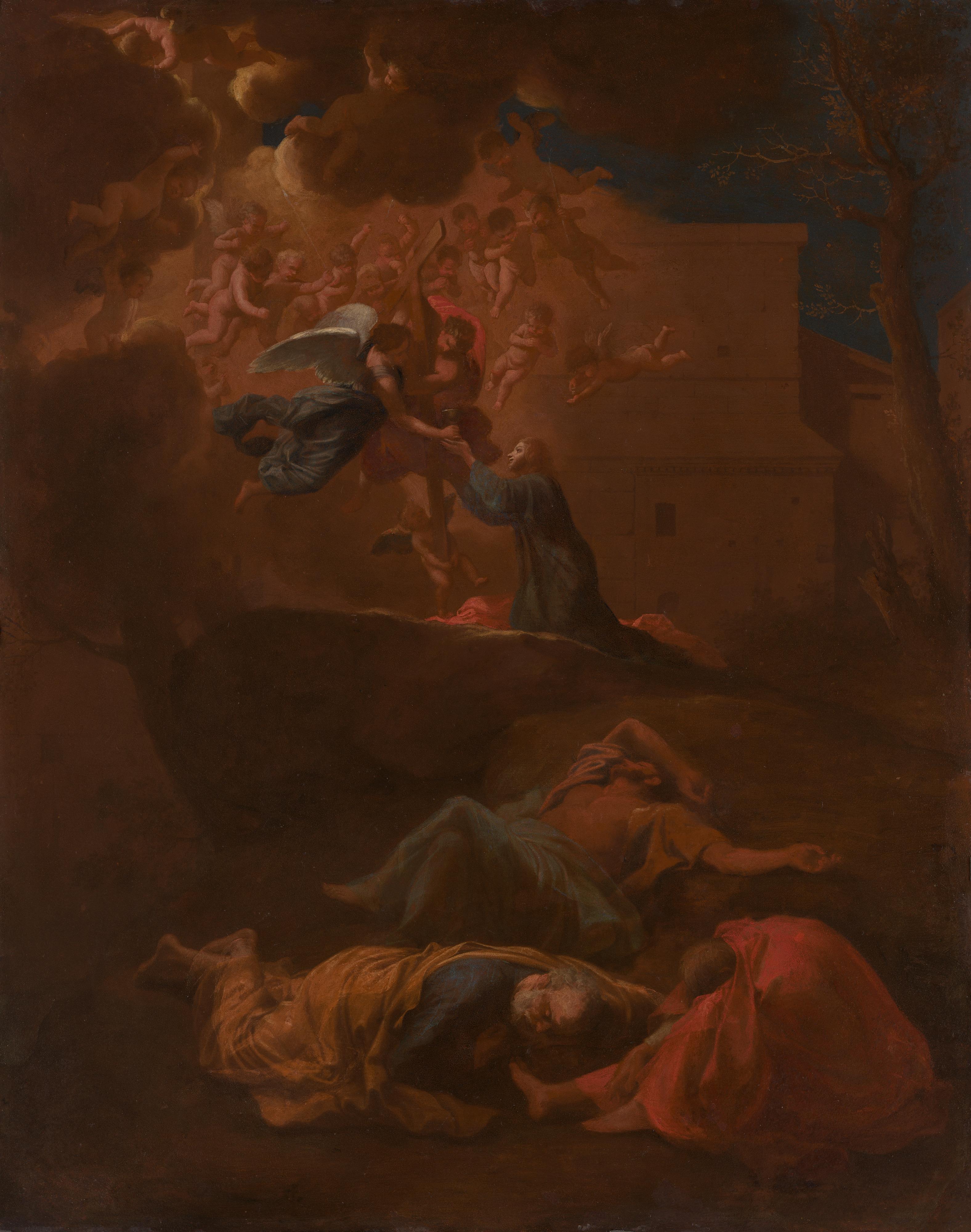
The Agony in the Garden
Nicolas Poussin
715 likes45 comments
Paintale uses cookies for essential site functionality and, where enabled, to serve relevant advertising via Google AdSense. You can accept all cookies or reject non-essential ones. See our Privacy Policy for details.
Now viewing
Landscape with Saint John on Patmos
Nicolas Poussin
Period
1600-1650
Theme
Religion & Mythology
Medium
Oil on canvas
Current Location
Art Institute of Chicago, Chicago
The Story
Landscape with Saint John on Patmos (French: Paysage avec saint Jean à Patmos) is a 1640 neoclassical painting by Nicolas Poussin, now in the Art Institute of Chicago. The painting features Saint John, banished to Patmos, writing the Book of Revelation amidst a classical landscape background.
Created in 1640 during the 1600-1650 period, this work belongs firmly within the religion & mythology tradition. Nicolas Poussin worked at a moment when the rivalry between Catholic Baroque drama and Protestant restraint reshaped what a painting could mean. Every gesture, fabric, and gleam of light was decoded by contemporary viewers like a private language.
Working in Oil on canvas at 100.3 × 136.4 cm (39 1/2 × 53 5/8 in.); Framed: 128.6 × 164.1 cm (50 5/8 × 64 5/8 in.), Nicolas Poussin constructs depth through value contrast rather than outline, letting figures emerge from darkness the way they would under candlelight or through a shuttered window.
Look closely and the painting opens up. Objects you might pass over — a folded letter, a half-drawn curtain, the angle of a glance — were placed to be read. Figures and gestures here follow a visual vocabulary contemporary viewers would have read fluently — attributes, poses, and settings that identify who is who and what is at stake.
Art Institute of Chicago in Chicago now holds the work, where conservators and historians continue to revisit its condition and attribution. Each generation of scholarship adds a layer to how Nicolas Poussin's output from this period is understood.
“A silence so complete it becomes its own witness.”
John of Patmos.
In Christian tradition, Saint John the Evangelist is thought to be the youngest of Christ’s twelve disciples—but Nicolas Poussin depicted him here as an elderly man. The disciple has retired to the Greek island of Patmos to write the Gospel of John and the Book of Revelation; he is shown at work with his attribute, an eagle, just behind him. Poussin constructed an idealized landscape, shaping natural forms according to geometric principles and reinforcing the measured order of the composition by arranging them parallel to the picture plane. The resulting serene setting is replete with references to Greco-Roman civilization, including column fragments, an obelisk, and a temple. For Poussin and his friends and patrons, Christianity was closely linked to Stoic philosophy, which emphasized reason, unity, and serenity. Scholars now regard Poussin’s art, more than that of any other seventeenth-century European artist, as synonymous with classicism, the philosophy that prized the model of ancient Greek and Roman art and architecture. Born in France, Poussin spent most of his career in Rome, painting for an educated elite. Along with Landscape with Saint Matthew (Gemäldegalerie, Berlin), painted the same year, Landscape with Saint John on Patmos may have been part of a planned series including all four evangelists.
A. A. Munger Collection
Materials: oil paint, canvas.
Technique: oil painting, painting, painting techniques, painting (image making).
Commissioned by abate Gian Maria Roscioli (died 1644), Rome, and paid for, with its pendant (Landscape with Saint Mathew, now Berlin, Gemäldegalerie) on October 28, 1640 for 40 écus [documents published by Barroero 1979 and Corradini 1979). Probably in a French collection by 1680 [when engraved by Louis de Châtillon, c. 1680]. François-Antoine Robit, Paris, sold Paillet and Delaroche, Paris, May 11 and following, 1801, no. 91, to Naudou acting for Michael Bryan, for Fr 7,100 [see Edwards 1996, pp. 299, 304]; sold by Bryan, probably shortly thereafter, to Sir Simon Clarke, Bt (died 1832), Oakhill, Hertfordshire, for 1,000 gns. [see Buchanan 1824; with George Hibbert, Clarke had provided financial support for Bryan’s purchases at the Robit sale]; sold Christie’s, London, May 8-9, 1840, no. 39, to Geddes for 86 gns. [price and buyer in annotated catalogue at the Frick Art Reference Library]; Andrew Geddes, A.R.A. (died 1844), London; by descent to his widow, Adela Plimer Geddes (died 1881), offered for sale, Christie’s, London, April 12, 1845, no. 651, bought in; offered for sale, Christie’s, London, November 30, 1867, no. 56, bought in [annotated catalogue from Christie’s archive, copy in curatorial file]. Acquired on the London art market by Max Rothschild, 1918 [according to Blunt 1966; in London 1960 Blunt stated that Rothschild acquired the picture in 1928]. Possibly identical with the picture that was sold at Christie’s, London, December 16, 1927, no. 86, to Leger for £21[see Art Prices Current, n.s. 7 London, 1928, p. 105, the dimensions given as 40 x 52 1/2 inches; see also Posse 1930]. E. A. Fleischmann Gallery, Munich, by 1930; sold to the Art Institute, 1930.
Art Institute of Chicago, Chicago. View on the museum’s official page.
See more works at Art Institute of Chicago or browse the full Nicolas Poussin collection.
A restrained palette and sculptural lighting create a solemn geometry. The wooden crate and letter anchor the narrative with journalistic precision.
Sources
Keep Exploring
More paintings like this
Nicolas Poussin
Nicolas Poussin
Pasquale Ottino Italian
Nicolas Poussin
Nicolas Poussin
Nicolas Poussin
Bartolomé Esteban Murillo
Andrea Sacchi