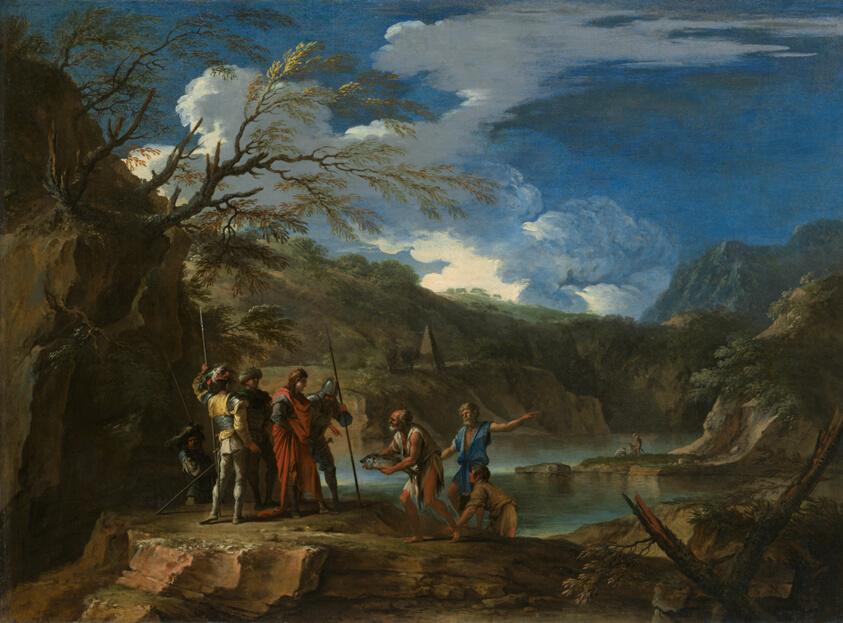
Polycrates and the Fisherman
Salvator Rosa
1336 likes26 comments
Paintale uses cookies for essential site functionality and, where enabled, to serve relevant advertising via Google AdSense. You can accept all cookies or reject non-essential ones. See our Privacy Policy for details.
Now viewing
Polycrates' Crucifixion
Salvator Rosa
Period
1650-1700
Theme
Tragedy & Death
Medium
Oil on canvas
Current Location
Art Institute of Chicago, Chicago
The Story
A native of Naples, Salvator Rosa settled in Rome in 1649, producing dramatic works regarded as counterparts to the calm, classical landscapes of his contemporaries Claude Lorrain and Nicolas Poussin. Rosa’s landscapes present nature as wild, filled with striking effects of light, jagged cliffs, and dark grottoes. These qualities underline the eerie mood in his depiction of the death of Polycrates, ruler of the Greek island of Samos.
Together with its companion piece Polycrates and the Fisherman, it illustrates the king’s inability to escape the ups and downs of fortune to which all humans are subject.
Working in Oil on canvas at 73.4 × 98.9 cm (28 7/8 × 38 15/16 in.); Framed: 87 × 112.4 × 7 cm (34 1/4 × 44 1/4 × 2 3/4 in.), Salvator Rosa constructs depth through value contrast rather than outline, letting figures emerge from darkness the way they would under candlelight or through a shuttered window.
Look closely and the painting opens up. Objects you might pass over — a folded letter, a half-drawn curtain, the angle of a glance — were placed to be read. Light hardens into edge, drapery becomes shroud, and the body is staged like an argument about mortality.
Housed at Art Institute of Chicago in Chicago, the painting has passed through the hands of collectors, dealers, and institutions before reaching public view — a provenance that is itself part of the object's story.
“A silence so complete it becomes its own witness.”
A native of Naples, Salvator Rosa settled in Rome in 1649, producing dramatic works regarded as counterparts to the calm, classical landscapes of his contemporaries Claude Lorrain and Nicolas Poussin. Rosa’s landscapes present nature as wild, filled with striking effects of light, jagged cliffs, and dark grottoes. These qualities underline the eerie mood in his depiction of the death of Polycrates, ruler of the Greek island of Samos. Together with its companion piece Polycrates and the Fisherman, it illustrates the king’s inability to escape the ups and downs of fortune to which all humans are subject.
Wentworth Greene Field Memorial Fund
Technique: oil painting, painting techniques, painting (image making), painting.
Bonaventura Argenti (died 1697), Rome; by descent to Argenti’s heirs, Rome 1697 to 1698 [“Due quardri da Quattro palmi in circa, con due Historie di Policrate cornice dorata di Salvator Rosa, Scudi “Two pictures, each about four palms across, with two histories of Policrates framed in gold by Salvator Rosa, 250 Scudi; Giuseppe Ghezzi, “Quadri delle case de Prencipi in Roma,” 1686–1717, MS. 93, Palazzo Braschi, Rome, c. 283; published by Meroni 1978, p. 89 and de Marchi 1987, pp. 384, 392–93]; consigned for sale to Giuseppe Ghezzi, Rome, about 1698 [see Ghezzi 1686–1717 cited above]. Probably 2nd Earl of Warwick, (Warwick Castle) by 1801 [auction of June 1, 1801 at Christie’s, bought in, see Fredericksen and Zeri 1972]. Schaeffer Galleries, New York, 1942 [see New York 1942, no. 30]. A. F. Mondschein, New York by 1942; sold to the Art Institute, 1942.
Art Institute of Chicago, Chicago. View on the museum’s official page.
See more works at Art Institute of Chicago or browse the full Salvator Rosa collection.
A restrained palette and sculptural lighting create a solemn geometry. The wooden crate and letter anchor the narrative with journalistic precision.
Sources
Keep Exploring
More paintings like this
Salvator Rosa
David Teniers the YoungerAfter Paolo Veronese
Jacques Louis David
Caravaggio
Guido Cagnacci

Sandro Botticelli

Sandro Botticelli

Hieronymus Bosch