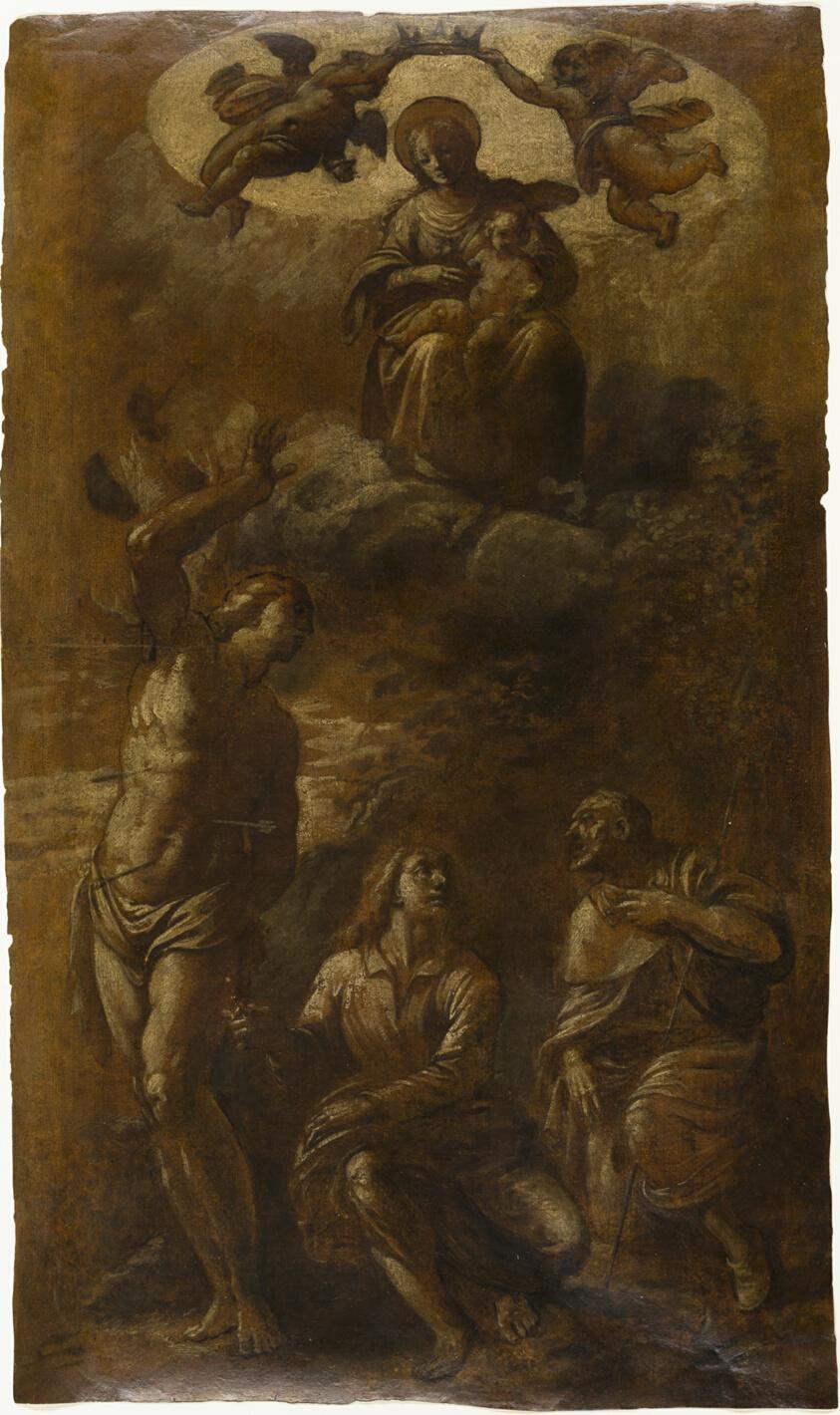
Virgin and Child in Glory with Saints Sebastian, John the Evangelist, and Roch
Pasquale Ottino Italian
1565 likes95 comments
Paintale uses cookies for essential site functionality and, where enabled, to serve relevant advertising via Google AdSense. You can accept all cookies or reject non-essential ones. See our Privacy Policy for details.
Now viewing
Ecce Agnus Dei
Bartolomé Esteban Murillo
Period
1600-1650
Theme
Religion & Mythology
Medium
Oil on canvas
Current Location
Art Institute of Chicago, Chicago
The Story
This is one of four large canvases devoted to the life of Saint John the Baptist that Bartolomé Esteban Murillo painted for the convent of San Leandro in his native Seville, Spain. Inscriptions from the gospels of John and Luke float in the sky, accompanied by the eagle and winged bull that, respectively, symbolize these evangelists. John the Baptist’s gesture toward Jesus alludes to the Baptist’s role in preparing the way for Christ.
When he painted this series, Murillo was transitioning away from the hard edges and dramatic shading inspired by Francisco de Zurbarán toward softer, more vaporous effects.
As Oil on canvas (270.2 × 184.5 cm (106 3/8 × 72 5/8 in.); Framed: 317 × 232 cm (124 13/16 × 91 3/8 in.)), the work shows the tool marks and layering choices typical of Bartolomé Esteban Murillo's output in this period — decisions about ground, underpainting, and glaze that a photograph can only partly convey.
Look closely and the painting opens up. Objects you might pass over — a folded letter, a half-drawn curtain, the angle of a glance — were placed to be read. The iconography draws on scripture and classical myth, but the emotional weight is entirely human.
Today the painting is held by Art Institute of Chicago in Chicago, where it remains a touchstone for understanding Bartolomé Esteban Murillo's contribution to Western art. It has been studied, copied, restored, and argued over for centuries — proof that great paintings keep generating new readings long after their creators have gone.
“A silence so complete it becomes its own witness.”
This painting features documented symbols with their own dedicated meaning in art history:
This is one of four large canvases devoted to the life of Saint John the Baptist that Bartolomé Esteban Murillo painted for the convent of San Leandro in his native Seville, Spain. Inscriptions from the gospels of John and Luke float in the sky, accompanied by the eagle and winged bull that, respectively, symbolize these evangelists. John the Baptist’s gesture toward Jesus alludes to the Baptist’s role in preparing the way for Christ. When he painted this series, Murillo was transitioning away from the hard edges and dramatic shading inspired by Francisco de Zurbarán toward softer, more vaporous effects.
Louise B. and Frank H. Woods Purchase Fund
Technique: oil painting, painting techniques, painting (image making), painting.
Painted for the refectory of the Augustinian convent of San Leandro, Seville, together with three other paintings of the life of St. John the Baptist and a one of Saint Augustine washing Christ’s feet [see correspondence of Francisco de Bruna and the Conde del Aguila, about 1781 published by Carriazo 1929, p. 180]; sold by the convent to Antonio Bravo, Seville, 23 June 1812 [manuscript catalogue, Bravo Collection, University of Seville, according to Baticle and Marinas 1981]; his brother, Aniceto Bravo, sold together with an unknown Murillo and three other paintings to Luis Bouisson for M. Dauzat, probably on behalf of Baron Taylor for the collection of King Louis-Philippe of France, by September 1837 [see Angulo Íñiguez 1981, p. 21 and Baticle and Marinas 1981]; Louis-Philippe, Paris and London, by 1838 (d. 1850) [according to Notice des tableaux..., 1838]; his heirs, sold Christie’s, London, 6-21 May 1853, no. 74, for £660 [there is some confusion about the buyer at the Louis-Philippe sale: though the Illustrated London News, 21 May 1853, p. 400 states that it was bought by Farrer for a client in Manchester, the copy of the auctioneer’s book in Christie’s archives appears to be marked to Steward, Stewand or Towend, copy and letter of Estelle Gittens dated 20 December 2000 in curatorial file; since the painting was later in the collection of Thomas Townend, Manchester, both may be correct; there is no evidence that it was ever in the collection of the duc de Montpensier as reported by Tubino 1864 and Roberts 1897]; Thomas Townend (d. 1865) of Manchester and later Brighton, presumably by descent to his daughter Elizabeth Shepherd Townend Hall (d. Feb. 1883), Syndale, Kent by 1865 until 1883; offered for sale as from the estate of Thomas Townend, Brighton, Christie’s, London, 14 July 1883, no. 73, bought in at 110 guineas [73 written in chalk and a stencilled 130S, both on the back of the painting, confirm that it was in this sale; see email from Lynda McLeod, Christie’s, 26 Feb. 2002; annotated catalog says £115.10 to Purvis]; by descent to Blanche Mary Townend Hall Bullen (d. 1886); on her death to her husband Major John Bullen Symes Bullen, whom she had married on 26 June 1884 [this geneology clarified in a letter of 24 June 2002 from Arthur Percival, the Faversham Society, to Tiffany Johnston in curatorial file]; by descent to Lt.-Colonel John Fitzherbert Symes Bullen of Catherston-Leweston, Dorset [according to Soria 1960 and Bullen’s daughter, Jennie Loriston-Clarke, who remembered seeing it in the hall of her father's home; conversation of 8 May 2002 with Tiffany Johnston]. Appleby Brothers, London, by June 1954 [according to Burlington Magazine 1954]; sold by Appleby Brothers to Agnew’s, London, 19 July 1954 [according to letter of 3 September 1998 from Christopher Kingzett in curatorial file]; sold to Art Institute of Chicago, 1960.
Art Institute of Chicago, Chicago. View on the museum’s official page.
See more works at Art Institute of Chicago or browse the full Bartolomé Esteban Murillo collection.
A restrained palette and sculptural lighting create a solemn geometry. The wooden crate and letter anchor the narrative with journalistic precision.
Sources
Keep Exploring
More paintings like this
Pasquale Ottino Italian
Nicolas Poussin
Andrea Sacchi
Anthony van Dyck

Leonardo da Vinci

Leonardo da Vinci

Leonardo da Vinci

Leonardo da Vinci