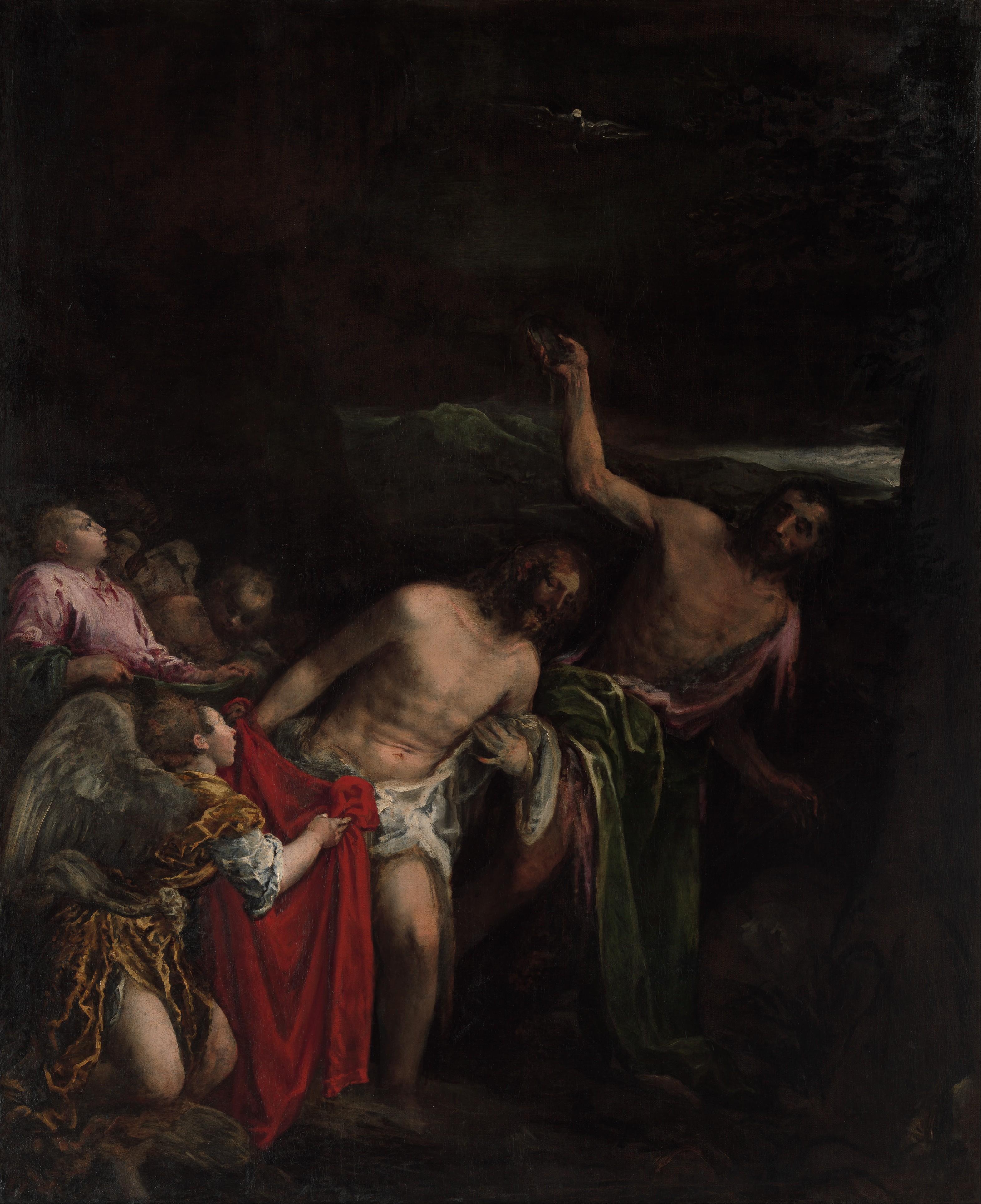
The Baptism of Christ
Jacopo Bassano
1232 likes82 comments
Paintale uses cookies for essential site functionality and, where enabled, to serve relevant advertising via Google AdSense. You can accept all cookies or reject non-essential ones. See our Privacy Policy for details.
Now viewing
Diana and Actaeon
Jacopo Bassano
Period
1550-1600
Theme
Power & Politics
Medium
Oil on canvas
Current Location
Art Institute of Chicago, Chicago
The Story
According to Roman myth, Actaeon, a mortal youth, was out hunting when he came upon Diana, the goddess of the moon and the hunt, bathing with her nymphs in a secret grotto. To punish him for his intrusion, Diana transformed Actaeon into a stag, and he was subsequently killed by his own hounds. With its poetic, silvery light and broken, dabbed brushstrokes, this small painting is a rare example of Jacopo Bassano’s hand at the end of his career.
Working in the small town of Bassano del Grappa, Jacopo was one of the most influential painters in Venice and the surrounding region. His four sons carried his lively, colorful, and naturalistic style forward into the 17th century.
Executed in Oil on canvas, measuring 63.6 × 68.7 cm (25 × 27 in.); Framed: 82.6 × 88.3 × 10.2 cm (32 1/2 × 34 3/4 × 4 in.), the surface rewards close looking. Jacopo Bassano builds the composition through layered glazes and a tightly controlled palette, letting cool shadows recede so that the warm, lit passages step forward.
Look closely and the painting opens up. Objects you might pass over — a folded letter, a half-drawn curtain, the angle of a glance — were placed to be read. Scale and setting do political work here, elevating the subject above the room it would have hung in.
Housed at Art Institute of Chicago in Chicago, the painting has passed through the hands of collectors, dealers, and institutions before reaching public view — a provenance that is itself part of the object's story.
“A silence so complete it becomes its own witness.”
This painting features documented symbols with their own dedicated meaning in art history:
According to Roman myth, Actaeon, a mortal youth, was out hunting when he came upon Diana, the goddess of the moon and the hunt, bathing with her nymphs in a secret grotto. To punish him for his intrusion, Diana transformed Actaeon into a stag, and he was subsequently killed by his own hounds. With its poetic, silvery light and broken, dabbed brushstrokes, this small painting is a rare example of Jacopo Bassano’s hand at the end of his career. Working in the small town of Bassano del Grappa, Jacopo was one of the most influential painters in Venice and the surrounding region. His four sons carried his lively, colorful, and naturalistic style forward into the 17th century.
Charles H. and Mary F. S. Worcester Collection
Technique: painting, oil painting, painting (image making), painting techniques.
Possibly Jacopo Bassano (died 1592), Venice [inventory of studio content dated April 27, 1592, drawn up shortly after the artist’s death, "No. 130. L’Istoria d’Ateo, d’un braccio d’ogni banda" (The Story of Actaeon, one braccio in every direction); see Giambatista Verci, "Notizie intorno alla vita e alle opere de’pittori, scultori e intagliatori dell città di Bassano," Venice, 1775, p. 75]. Dupille, Paris, by 1763 [engraved by E. Fessard; see Crozat, 1763.] E. and A. Silberman Galleries, New York, by 1939 [Letter from Charles H. Worcester's secretary to Silberman of October 5, 1939, in curatorial file]; sold by Silberman to Charles H. Worcester, Chicago, 1939; given to the Art Institute, 1939.
Art Institute of Chicago, Chicago. View on the museum’s official page.
See more works at Art Institute of Chicago or browse the full Jacopo Bassano collection.
A restrained palette and sculptural lighting create a solemn geometry. The wooden crate and letter anchor the narrative with journalistic precision.
Sources
Keep Exploring
More paintings like this
Jacopo Bassano
Tintoretto
Anthony van Dyck

Leonardo da Vinci

Leonardo da Vinci
James McNeill Whistler
Moretto da Brescia

Correggio