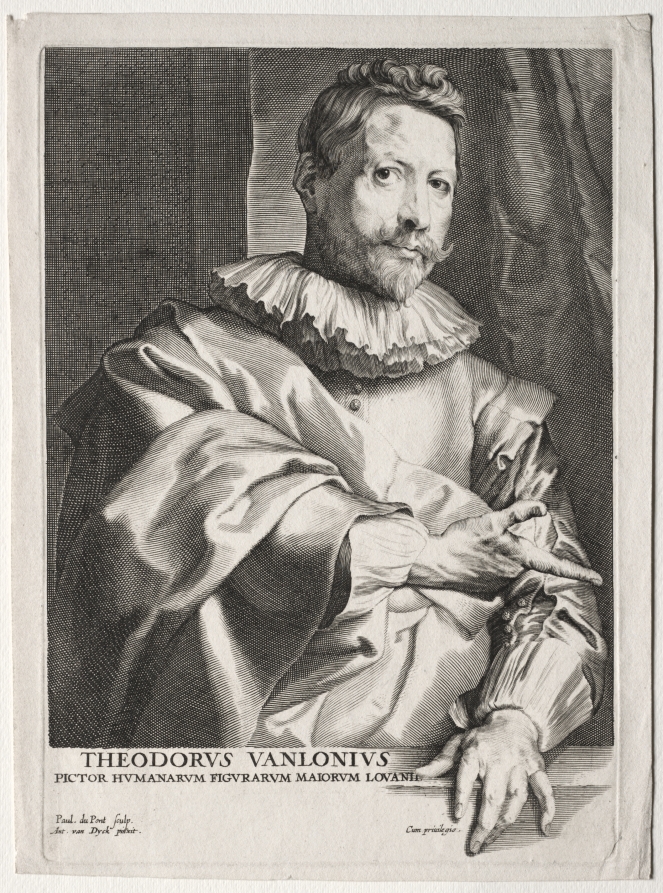
Theodoor Van Loon
Paulus Pontius • 1630 • Cleveland Museum of Art
Theodoor van Loon (1581 or 1582 – February 1649) was a Flemish Baroque painter.
Created in 1630 during the Baroque period, this work belongs firmly within the daily life tradition. Paulus Pontius worked at a moment when the rivalry between Catholic Baroque drama and Protestant restraint reshaped what a painting could mean. Every gesture, fabric, and gleam of light was decoded by contemporary viewers like a private language.
Executed in engraving, measuring Sheet: 26.2 x 19.3 cm (10 5/16 x 7 5/8 in.); Platemark: 24.8 x 17.6 cm (9 3/4 x 6 15/16 in.), the surface rewards close looking. Paulus Pontius builds the composition through layered glazes and a tightly controlled palette, letting cool shadows recede so that the warm, lit passages step forward. The brushwork shifts from the precise to the almost dissolved — a hallmark of mature Baroque practice.
Look closely and the painting opens up. Objects you might pass over — a folded letter, a half-drawn curtain, the angle of a glance — were placed to be read. Even the everyday is loaded: a basin, a candle, a worn shoe become small monuments to a vanished daily world.
Today the painting is held by Cleveland Museum of Art in Cleveland, where it remains a touchstone for understanding Paulus Pontius's contribution to Western art. It has been studied, copied, restored, and argued over for centuries — proof that great paintings keep generating new readings long after their creators have gone.